
Meme Guidance for Faculty
Faculty: 1-min meme dialogue & value analysis
Meme Guidance for Faculty
Faculty: 1-min meme dialogue & value analysis
Showcase
Description
College students' use of internet memes requires guidance, not just management. College students aren't ignorant of memes; they often use them to express attitudes, stress, sarcasm, doubt, and group identity. The problem is that some memes can overly trivialize serious discussions, some can mask real stress, and some may involve offensive expressions related to gender, region, appearance, illness, or class. Faced with such situations, college faculty cannot simply 'ban' them; they need to turn internet language into an entry point for classroom discussion, value analysis, and expression training. This Skill is designed for college ideological and political course teachers, counselors, class advisors, general education teachers, employment guidance teachers, and student affairs workers. This Skill integrates college classroom teaching experience, youth internet culture observation, and real educational communication practice. It does not simply view students' meme use as a 'classroom problem,' but helps teachers understand the underlying emotions, attitudes, and value tendencies, and transform them into more educationally valuable classroom resources.
Related Skills
View all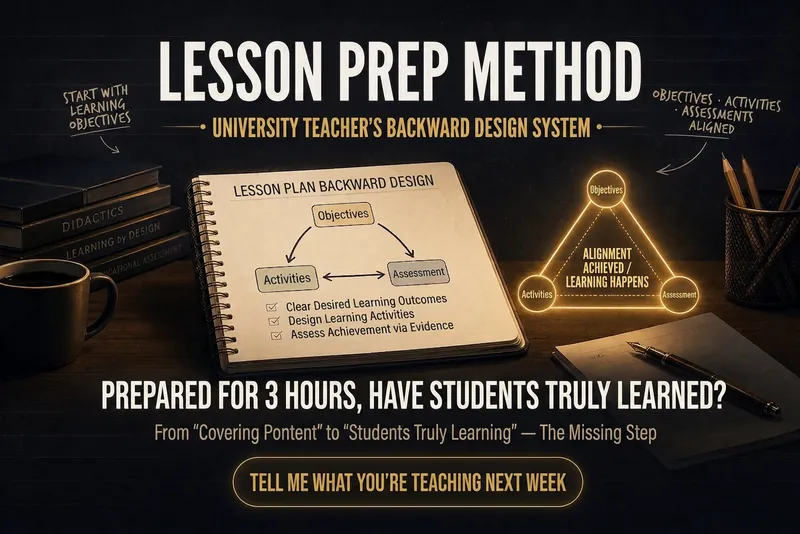
Backward Design for Lessons
‼️ Have you ever had this feeling?— You spend three hours preparing a lesson, your PPT looks great, you deliver it smoothly on stage, but afterward, there's an indescribable emptiness: Did the students really learn? It's not that you didn't try hard enough. It's because you've fallen into the most hidden trap in higher education: Confusing "covering content" with "completing teaching." Why does more preparation sometimes lead to worse results? Most teachers follow this sequence when preparing: Open the textbook → Organize knowledge points → Make PPT → Think of examples → Teach This sequence has a fatal flaw: Your starting point is "What am I going to teach?" rather than "What can students do after class?" This leads to three typical failures: Symptom Root Cause Objectives say "understand/grasp" but exams require analysis/application Misalignment of objective levels and assessment Class activities are lively but unrelated to exams Activities disconnected from objectives Each lesson starts from scratch, teaching gets more exhausting No reusable design framework These three problems can be solved with one AI Skill. What is "Backward Design for Lessons"? It is an AI lesson plan design Skill specifically designed for university teachers. Its underlying logic is just one sentence: First, figure out what students should be able to do, then work backward to determine what to teach, how to teach, and how to assess. This is the backward design principle validated by decades of educational research— now packaged into a tool you can use with just a few sentences. How easy is it to use? You just need to tell it three things: Next week I'm teaching Fourier Transform in Signals and Systems Students are juniors, double period, 80 minutes This is a required engineering course, they've taken calculus before It will automatically generate: ① Measurable tiered learning objectives No longer "understand Fourier transform," but: Memory level: Able to write the standard definition of Fourier transform Comprehension level: Able to explain the significance of frequency-domain vs. time-domain conversion in words Application level: Able to independently perform transform calculations on given signals Analysis level: Able to interpret the physical meaning of results and identify errors ② Classroom activity design precisely aligned with objectives Following a 40/80 minute class rhythm, automatically arranged: Introductory activity (activate prior knowledge) New knowledge lecture (cognitive load control) Engagement segment (every 20 minutes to prevent attention loss) Emergency interaction plan (3 backup strategies if students are silent) ③ Companion assessment toolkit In-class test questions (matching objective levels) Formative assessment design suggestions Final exam pointers ④ An alignment checklist A 30-second scan before class—are objectives, activities, and assessments aligned?
Course Ideological Inspiration
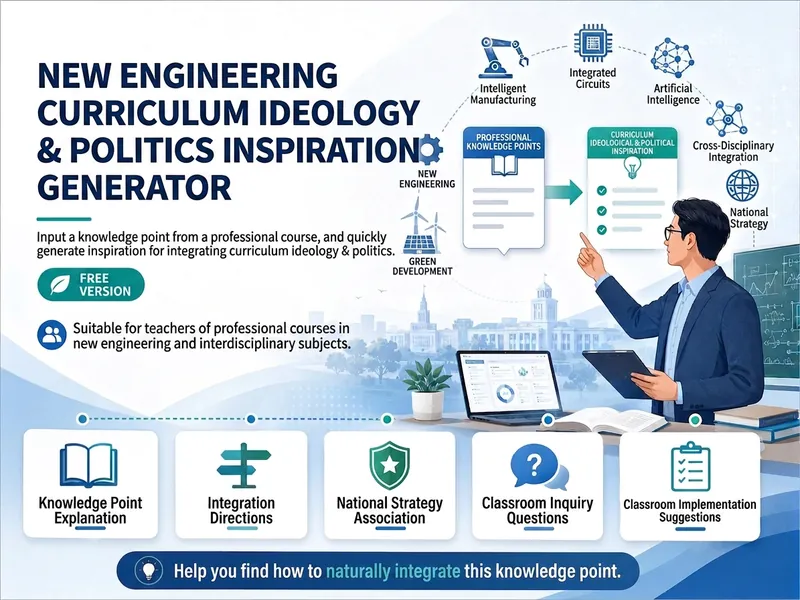
Many teachers of new engineering courses know the importance of ideological and political education in courses, but they don't know how to integrate it into their specific knowledge points, how to avoid forced elevation, or where to start in class. This Skill is designed for teachers of new engineering and interdisciplinary courses such as intelligent manufacturing, smart materials, mechanical engineering, automation, computer science, artificial intelligence, electrical control, and materials science. It helps you start from a specific knowledge point and quickly gain inspiration for ideological integration. Simply enter the course name, chapter/knowledge point, and target audience, and I will generate: - A brief explanation of the knowledge point; - 2-3 natural integration directions; - Related national strategies or real-world context; - 3 thought-provoking classroom questions; - A short suggestion for classroom use. This free version is suitable for teachers to quickly assess whether a knowledge point has room for ideological integration. If you need a complete plan including case materials, question chains, 1-minute/3-minute teaching scripts, student activities, lesson plan/PPT embedding suggestions, and three-dimensional evaluation methods, you can use the paid version: 'New Engineering Course Ideological Integration Plan Generator'. This Skill is suitable for: - Teachers of new engineering courses trying ideological integration for the first time; - University teachers revising lesson plans, PPTs, or instructional designs; - Teachers who want to quickly find an entry point for ideological integration but do not yet need a complete plan; - Teachers of courses in intelligent manufacturing, smart materials, mechanical engineering, automation, computer science, artificial intelligence, materials, etc.
Smart Unit Design Starter v2.0
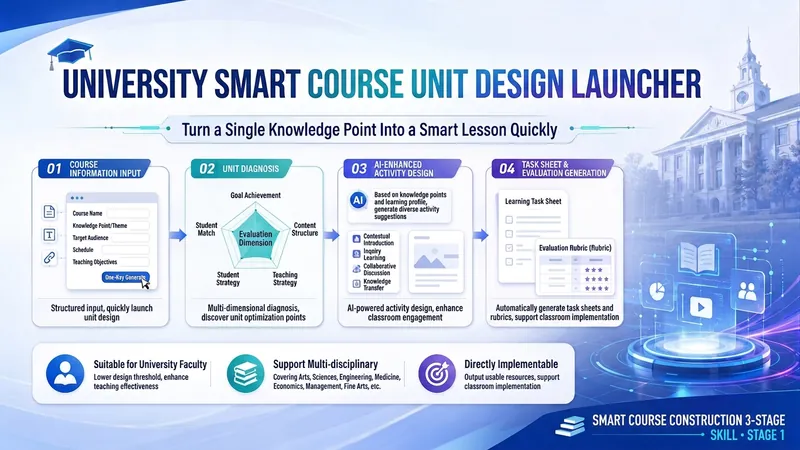
Turn a knowledge point into a smart teaching plan ready for class. This Skill is designed for college teachers who want to build smart courses but don't know where to start. Teachers only need to provide the course name, teaching topic, target students, and class hours to generate a complete, ready-to-implement unit-level smart teaching design. It helps you: 1. Restructure teaching objectives across three dimensions: knowledge, ability, and quality; 2. Design a truly actionable AI-enhanced classroom activity; 3. Form a complete teaching process covering pre-class, in-class, and post-class; 4. Generate student task sheets and multi-dimensional evaluation rubrics; 5. Clarify AI usage boundaries, teacher review points, and classroom backup plans. Suitable for courses in humanities, STEM, medicine, art and design, economics and management, ideological and political education, and other higher education subjects. After opening the Skill, follow the prompts to fill in basic course information, and a teaching plan will be generated. Teachers are not required to master complex prompts or prepare complete course materials in advance.
Information
- Version
- v3
- Last updated
- Runtime credits
- Usage-based
- Models
- Auto