
Theory Midas V2.0
Match, explain, integrate theory for academia
Theory Midas V2.0
Match, explain, integrate theory for academia
Showcase
Description
Theory Midas V2.0 is a theoretical practice transformation engine built specifically for humanities and social science researchers. It directly addresses three major pain points in academic writing: 'not knowing which theory to use, forced application of theories, and superficial discussion.' Its core functionality consists of three progressive steps: precise matching, thorough explanation of logic, and seamless integration.
Related Skills
View all Write
WriteFull-Process Academic Writing
"Full-Process Academic Writing" is an intelligent assistant tool designed for researchers, aimed at covering every stage of academic paper writing from initial conception to final submission. Whether you have just a vague research direction or have a draft that needs polishing, this tool provides systematic support to help you efficiently produce high-quality academic work. This tool guides you through four key stages. First is **Topic Planning**, which helps you refine preliminary ideas into concrete, feasible research topics and questions, and generates a comprehensive Topic Evaluation Report covering research framework, method matching, timeline planning, and resource bottleneck identification. Next is the **Literature Review** stage, assisting you in building search strategies, organizing core literature, and writing a logically rigorous literature review draft that identifies research gaps. The third stage is **Structured Writing**, where the tool designs a detailed paper outline based on your topic and literature review, and drafts the introduction, methods, body, and conclusions chapter by chapter, while also providing scientific chart code to ensure a complete structure and rigorous argumentation. Finally, the **Polishing and Revision** stage performs a comprehensive academic standard check, six-dimensional language polishing, and logical coherence review, and embeds an AI-assisted writing statement to ensure your final draft meets publishable professional standards. Throughout the writing process, this tool always adheres to academic ethics standards. All citations will be clearly flagged for verification and will never be fabricated. Output from each stage proceeds only after your confirmation, ensuring every step aligns with your research intent, allowing you to focus on expressing your ideas while leaving tedious formatting and standards to AI.
 Write
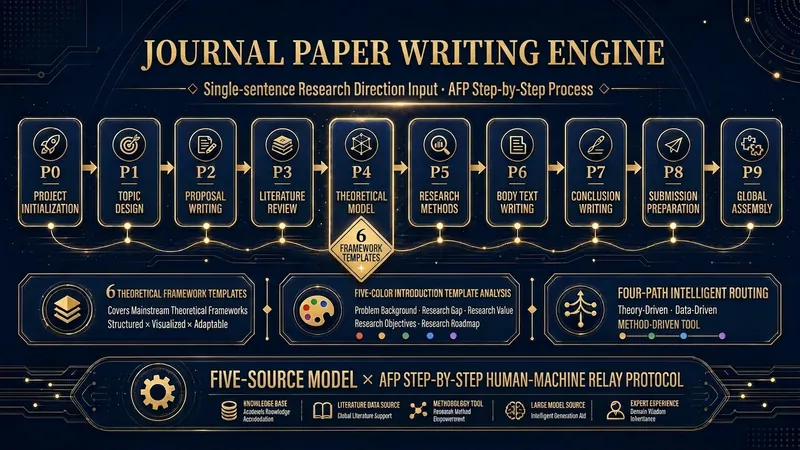
WriteJournal Paper Writing Engine
Input your research direction in one sentence, and the AFP step-by-step engine guides you through the entire process. P1 Topic Design — Davis Interesting Theory + Problematization’s Five-Level Topic Selection Method, extracting real problems from phenomena. P2 Introduction Writing — Five-Color Template Analysis Method, breaking down top journal model papers section by section: emotional appeal → knowledge gap → literature positioning → research space → value declaration, with embedded full deconstruction prompts. P3 Literature Review — Structured organization, distinguishing research threads and dialogue objects. P4 Theoretical Framework — Six theory integration templates embedded throughout (complementary, contrast, bridging, hierarchical, evolutionary, general), each containing six paragraphs: introduction → justification → sorting → premise → analysis → conclusion; plus a five-level deep-drill sentence skeleton for single-theory depth. P5 Research Methods — Automatically adapts strategies based on four paths: empirical quantitative, qualitative, speculative, and mixed. P6 Body Writing — 9-3-1 pyramid structure. P7 Conclusion Writing — Three-level conclusion processing (findings → dialogue → extension). P8 Submission Preparation — Eight methods to reduce AI detection rate. P9 Global Assembly — Compiles independent documents from each stage into a complete draft, supports cross-chapter bidirectional backfill, and allows interruption and iterative backtracking at any time. 🎯 Suitable for: Graduate students (master's and PhD) and early-career researchers aiming to submit to Chinese C-journals, core journals, or SSCI, especially those stuck on theoretical framework and introduction writing. ⚙️ Underlying Architecture: Five-Source Model × AFP Step-by-Step Human-Machine Relay Protocol, with heartbeat signals, mandatory stop points, and dual-core auditing.
 Research
Project Proposal Expert v3.0
From vague ideas to logically rigorous application materials, even ordinary technical personnel can complete a 10,000-word argumentation report in 2 hours. Core Features: Eliminate empty language in applications: automatically strip out filler words like 'high-level' and 'significantly improved', use SCQA framework + Pyramid Principle to write quantified, logically rigorous arguments. Accurately identify innovation patterns: automatically analyze project characteristics, match three modes (autonomous originality, integrated innovation, iterative micro-innovation), give compatibility score and recommendation, avoid failure due to mispositioned innovation. Prevent logic gaps in argumentation: exclusive 'five elements + three chapters' structured output method, from project rationale to innovation points tightly linked, master 10,000-word deep report + high-definition technology roadmap. Zero experience required: no idea? Just input a one-sentence project idea (e.g., 'want to make a quantum sensor for gas leak detection'), system automatically completes 6 phases, outputs complete application materials. Usage: Open the dialogue box and directly input your project idea or upload existing materials; the system will guide you through the entire process: information collection → innovation mode selection → brief argumentation generation → full report generation → technology roadmap generation. Each phase has a confirmation mechanism, and you can flexibly exit and iterate. About V3.2: The new V3.2 version integrates five methodologies: SCQA framework, SMART principles, Pyramid Principle, Comparison-Difference-Advantage method, and Three-Dimensional Value method. It has been refined through real-world cases in quantum detection, smart elderly care, energy management, and other fields, locking in the underlying logic of research proposal success—an essential tool for successful project applications! Application scenarios: ✅ National Natural Science Foundation applications ✅ Provincial/municipal science and technology plan projects ✅ Enterprise technology innovation project initiation ✅ Graduate thesis proposal writing ✅ Technology achievement transformation plan design Core advantages: 🎯 Efficiency increase by 10x: from 2-3 weeks to 2-3 hours 📊 Quality professional guarantee: quantified indicators, rigorous logic, prominent innovation points 🔄 Flexible and controllable: each phase can be confirmed, modified, or exited 📈 Validated by real cases: successfully generated multiple 10,000-word deep reports Typical output examples: ✅ 10,000-word deep argumentation report ✅ High-definition technology roadmap ✅ Structured brief argumentation ✅ SCQA diagnostic analysis report ✅ Innovation mode compatibility assessment
Information
- Version
- v6
- Last updated
- Runtime credits
- Usage-based
- Models
- Auto