
SCI Q1/Q2 Systematic Review Skill
SCI Q1/Q2 Systematic Review Skill
Showcase
Description
This is a REVIEW_LOOP template designed for SCI Q2 and above (Q1/Q2) academic standards. This template is no longer a simple 'article writing', but simulates the process of a Corresponding Author guiding a PhD student in conducting a Systematic Review. It enforces the PRISMA standard, critical analysis matrix, GAP analysis, and research agenda, which are standard features of high-score reviews. Simply input the review topic. Generate manuscripts, reference libraries, chart suggestions, and reviewer responses with one click.
Related Skills
View all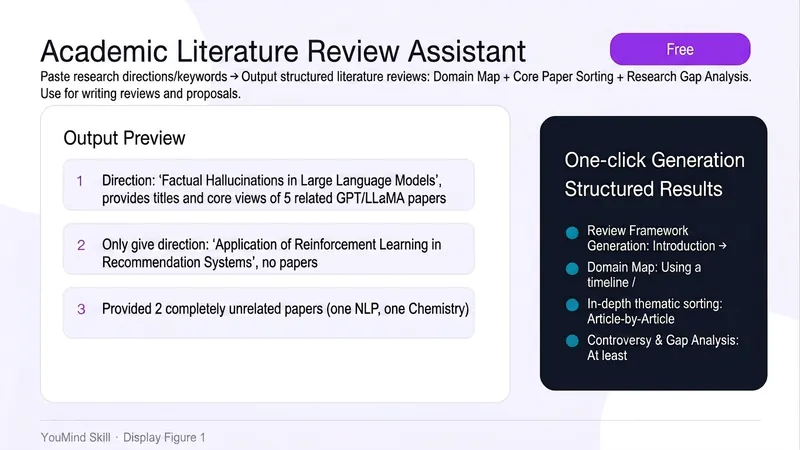
Literature Review Assistant
Writing a literature review is an inevitable challenge for graduate students—but turning information from 50 papers into a logically structured review, rather than a mere summary list, relies on methodology, not brute force. Tell it your research direction and the core papers you've already read. It first builds a framework—field map, thematic sorting, debates and gaps—then, after your confirmation, helps organize the language chapter by chapter. It doesn't write the paper for you, but helps you present the papers you've read with academic logic. ✨ Core Capabilities 1. Review framework generation: Introduction → Field map → Thematic sections → Debates and gaps → Outlook, standard academic structure 2. Field map: Sort domain development by timeline/school of thought, highlight milestone papers 3. In-depth thematic analysis: Individual paper introduction + intra-group comparison + overall contributions and limitations 4. Debate and gap analysis: At least 3 points of debate + 3 research gaps, with specific literature sources 5. Academic writing norms: Citation format, bilingual terminology, critical language rather than mere description 📱 Use Cases - Literature review chapter for graduate thesis/proposal writing - Related Work section of journal papers - Quick literature overview + structured notes when entering a new field - Used in combination with "论文速读笔记" and "论文双模研读" to form a "Read → Analyze → Synthesize" literature workflow ⚠️ Note: This skill does not perform real-time academic search. You need to provide information on papers you have already read (title/author/key points), and it helps you organize and write.
Management Paper Strict Review
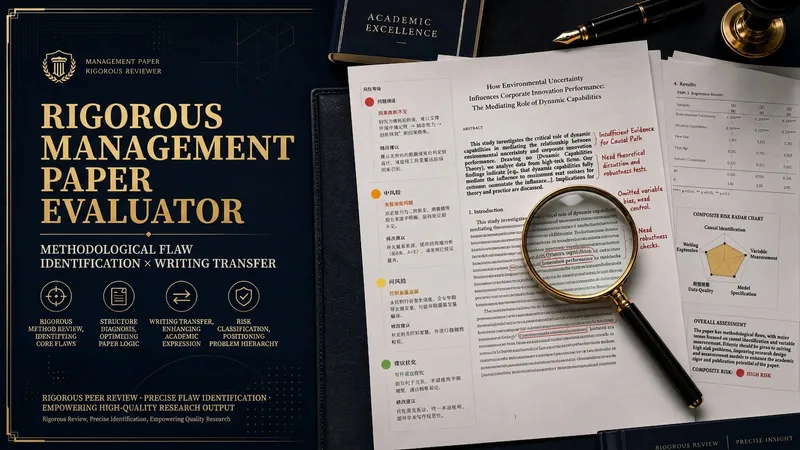
Have you encountered these problems? ❌ You cited a seemingly authoritative paper, only to have reviewers question, 'This study has severe endogeneity issues.' ❌ When writing a literature review, you're unsure whether a paper's conclusions are trustworthy. ❌ After reading dozens of papers, you still don't know how to apply others' writing techniques to your own paper. ❌ Before submission, you want to check for methodological risks but don't know which hard flaws top journal reviewers focus on. This Skill helps you: ✅ Quick mode (15–25 min): Determine whether a paper is worth reading in depth and can be cited confidently. ✅ Deep mode (45–60 min): Check methodological flaws item by item like an AMJ/ASQ/SMJ reviewer. ✅ Quantitative credibility rating: 🔴 Not citable / 🟠 Use with caution / 🟡 Reference only / 🟢 Safe to cite – at a glance. ✅ Writing transfer task card: Turn techniques from others' papers into executable tasks for your own Introduction/Methods/Results/Discussion sections. Covers seven methodology types: Quantitative regression, experimental studies, quasi-experimental causal identification, fsQCA, case studies, grounded theory, mixed methods. Output includes: - Six-area deep reading (theoretical dialogue, mechanism pathways, construct operationalization, method-data fit, contribution critique, writing techniques) - P1/P2/P3 risk levels (fatal/important/arguable) - Counterfactual testing (can the model explain reverse scenarios?) - Boundary condition check (5 dimensions: market/regulation/capital/technology/competition) - Writing transfer task card (specific techniques directly applicable to your own paper) In a nutshell: It is not a gentle paper summarizer. It's a strict academic writing assistant that helps you discover, 'Where can't this paper be trusted? What is worth learning from it? How can I apply it to my paper?' Suitable for you if you are: 📚 PhD/master's students writing literature reviews 📝 Management researchers preparing submissions to top journals 🔍 Reviewers needing quick paper quality assessments 📖 Paper writers wanting to learn top journal writing techniques
Teaching Paper Architect
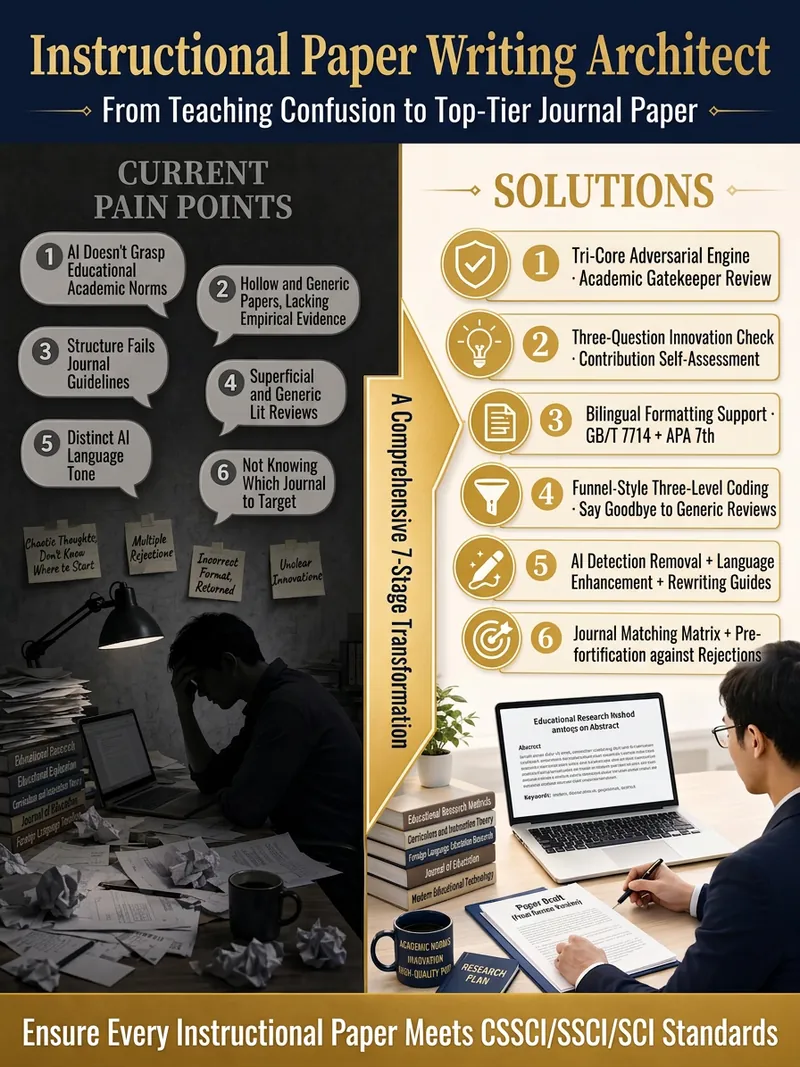
From teaching research accumulation to CSSCI/SSCI/SCI — making every teaching paper stand up to peer review. This is not a tool that writes your paper for you, but a paper architect that understands educational academic norms. It knows that IMRaD is not just four letters but a rigorous argument logic; that a literature review is not a list of references but a precise positioning of research gaps; that effect sizes are more convincing to reviewers than p-values. Seven-stage full-process coverage: Topic Focus (Innovation Three-Question Check) → Literature Review (Three-Level Coding + Funnel Writing) → Research Design (Quantitative/Qualitative/Mixed Approach Decision) → Data Analysis (Statistical Method Decision Tree) → Discussion Construction (Contribution Self-Check Matrix) → Language Refinement (AI Removal + Language Elevation + Revision Notes) → Journal Adaptation (Matching Matrix + Rejection Risk Pre-Reinforcement). Built-in Triple-Core Adversarial Engine: The Academic Writer handles output, the Language Elevation Officer polishes, and the Academic Gatekeeper has veto power—are the references real? Is the data reliable? Is the argument grounded in evidence? Does the contribution match the target journal level? Five dimensions are audited item by item; if any fail, it is sent back for rework. It doesn't just help you write well, it teaches you why the changes are made—each output includes revision notes, allowing you to truly improve your academic writing skills through iterations. Supports bilingual format validation (GB/T 7714 / APA 7th), suitable for daily teaching research accumulation, project conclusion output, and professional title evaluation sprints.
Information
- Version
- v5
- Last updated
- Runtime credits
- Usage-based
- Models
- Auto