
SCI Rebuttal Generator
From Chinese thoughts to polished rebuttals
SCI Rebuttal Generator
From Chinese thoughts to polished rebuttals
Showcase
Description
At the final stage of SCI paper publication, properly handling peer review comments is crucial. When facing a Major Revision or harsh review comments, authors often spend significant effort deciphering the reviewer's intent and crafting a response in rigorous, appropriate academic English. A single misstep in tone, logic, or format in the rebuttal letter can trigger negative emotions from reviewers, leading to eventual rejection and severely delaying research dissemination. This skill is specifically designed for graduate students, university faculty, and researchers, built on established best practices from top international journals and academic publishing standards. Simply input the reviewer's original comment and briefly describe your actual response in Chinese (no matter how straightforward), and the engine will automatically restructure the logic to generate: ✅ Academic Tone Restructuring: Convert plain Chinese ideas into objective, humble, and professional top-tier academic English, avoiding misunderstandings due to language habits. ✅ Standardized Point-by-Point Response: Strictly follow the point-by-point response paradigm favored by top international journals, with clear structure for rapid verification by editors and reviewers. ✅ Multi-Scenario Strategy Matching: Includes 5 professional response strategies (accept suggestion and revise, agree but need extensive revision, acknowledge limitations, define research scope, politely refute), providing airtight defensive phrasing. ✅ Taboo Expression Filter: Automatically identify and correct implied offensive expressions in rebuttals (like 'obviously', 'the reviewer is wrong'), ensuring tone remains appropriate. [Use Case Demo] 📝 Your Input: Reviewer's Comment: The experimental method is somewhat outdated. Why not use the latest Method X? Your Chinese Idea: Method X is indeed new, but it doesn't suit the specific materials of this study, and current experimental conditions cannot realize it. I have already added an explanation in the discussion section for why the current method was chosen. ✨ AI-Generated Top-Tier Response: Reviewer's Comment: The experimental method is somewhat outdated. Why not use the latest Method X? Author's Response: We are grateful for this insightful suggestion. While we recognize the value of Method X as a highly advanced approach, it falls outside the primary focus of the current study because our material system requires specific characterization conditions that Method X does not currently support. We have explicitly discussed this methodological choice and its rationale in the revised manuscript (Discussion Section, Page 8, Lines 234-241) to clarify this point. Action Taken: Added a new paragraph in the Discussion section (Page 8) explaining the rationale for the chosen method. [Academic Integrity Commitment] This skill strictly adheres to academic ethics: it does not fabricate references, invent experimental data, or make academic judgments for you. All response strategies are reconstructed based on the real information you provide; AI is only responsible for language restructuring and logical optimization. When your input is insufficient to generate a complete response, AI will clearly indicate what needs to be supplemented, never making up scientific reasons on its own. [Scope of Application] SCI / SSCI / EI journal revision submissions, conference paper rebuttals, peer review communications. Eliminate cross-language communication barriers, reduce energy loss during revision. Hand over the tedious response work to AI, allowing you to focus on research itself. Help your academic work achieve acceptance!
Related Skills
View all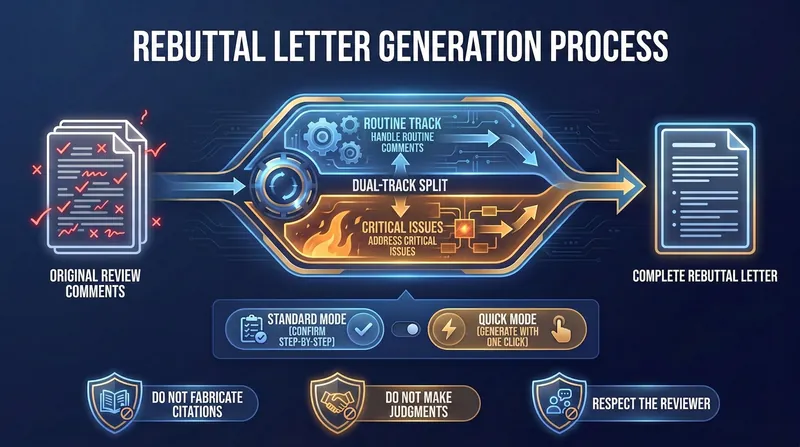
All-in-One Review Response V3.0
A full-process system for responding to peer review comments in social sciences and economics/management academic papers — from comment analysis, strategy formulation, and hard flaw defense to one-click assembly of a Rebuttal Letter. V3.0 Core Upgrades: · Governance layer: unified dashboard + 3 step modes (Standard/Fast/Slow) + ratchet version management + mid-process join logic · All 12 quick commands implemented (/quick /jump /skip /rerun /export /resume /tone /hardcase /conflict /cover /draft /lang) · Cross-step comment tracking table: tracks the status of each comment from Step 1 to Step 6 for closed-loop management · Complete library of 7 hard flaw diagnostics + subfield adaptation (Accounting/Finance/Management/Marketing/Labor Economics/Macroeconomics/Qualitative Research) · Full language pair support: Chinese→English / English→English / Chinese→Chinese, with automatic detection of review comment language · New revision Cover Letter generation + summary table of changes · Tone calibration system upgrade: forbidden expression list (20 items) + auto-correction + politeness score · Enhanced safety boundaries: anti-hallucination citation check + anti-overpromising check + AI-generated content transparency statement Applicable scenario: One-stop response writing for PhD students and early-career researchers in social sciences and management after receiving review comments.

Apex-Scholar Reviewer v5.1
The success rate of academic paper submissions is directly related to the logical rigor, linguistic authenticity, and format compliance of the manuscript. However, researchers often focus on scientific content itself and find it difficult to simultaneously balance critical review from a reviewer's perspective and Native Speaker-level language polishing. Additionally, different journals (e.g., IEEE's engineering style vs. Nature's narrative style) have vastly different requirements for writing style, further increasing the complexity of submissions. This system acts as a senior reviewer & academic writing mentor for Nature/Science-level journals, using a dual-core adversarial engine (Critic core responsible for logical attack, Mentor core responsible for language reconstruction) to perform comprehensive stress testing and refinement of the paper, ensuring the output can withstand the scrutiny of the most rigorous reviewers.
 Write
WriteAIGC Reduction & Rewrite v7.0
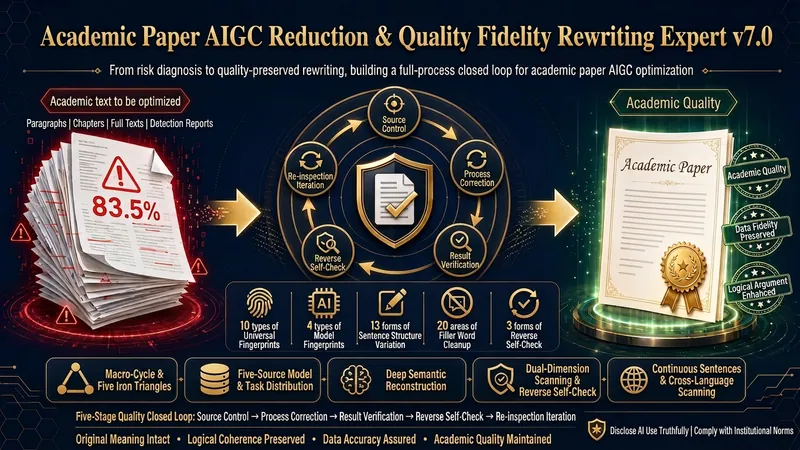
📚 Academic Paper AIGC Reduction and Quality-Preserving Rewriting Expert v7.0 Designed for graduate students, researchers, and paper authors, this academic text optimization skill operates on a core closed loop of 'source control → process correction → result verification → reverse self-check → iterative re-check'. It systematically diagnoses and optimizes issues such as templated expressions, mechanical logic, vague content, inaccurate terminology, and style inconsistencies while preserving original meaning, technical terms, data, and core conclusions. 🔍📝 🌟 Core Capabilities 🔬 Multi-layer Risk Diagnosis Covers 10 types of universal text fingerprints and assists in identifying common expression patterns of models such as ChatGPT, Claude, DeepSeek, and Wenxin Yiyan. 🧠 Deep Semantic Restructuring Goes beyond synonym replacement to rebuild more natural and in-depth academic reasoning by adjusting proposition expression, information order, argument approach, and evidence organization. ✍️ Quality-Preserving Rewriting Comprehensively applies 13 sentence transformation strategies and 20 methods for cleaning high-frequency templated expressions, improving mechanical sentence structures, repetitive connectors, and overly rigid formatting. 📊 Full-text Structure Diagnosis Through macro-cycle and five key triangles, checks whether research problems, theory, literature review, methods, results, conclusions, and innovation form a complete closed loop. 🧩 Fine-grained Section Adaptation Develops differentiated diagnostic and rewriting strategies for abstract, introduction, literature review, research methods, results, discussion, and conclusion respectively. 🌐 Cross-language Risk Scanning Assists in identifying translationese, passive voice stacking, long sentence nesting, and mixed Chinese-English formatting abnormalities to make Chinese academic expression more natural and accurate. 🔄 Reverse Self-check Loop After rewriting, re-verifies from three aspects: technique distribution, new text fingerprints, and information integrity, to avoid 'becoming more templated' or losing key content. 🛡️ Academic Integrity Protection Does not fabricate literature, data, cases, or policy evidence; separately marks information requiring author verification and reminds users to honestly disclose AI usage. 🎯 Use Cases ✅ Single paragraph or partial section optimization ✅ Targeted modification of marked paragraphs from inspection reports ✅ Polishing of abstract, introduction, literature review, discussion, and conclusion ✅ Full-text AIGC risk feature diagnosis ✅ Language and structure adaptation for target journals ✅ Pre-submission quality review and consistency check 📦 Final Deliverables 📄 Quality-preserving rewritten text 🔎 Risk and issue diagnosis report 🛠️ Rewriting strategy and technique description ✅ Reverse self-check and information integrity report 💡 Items requiring author verification and subsequent revision suggestions 🎓 Original meaning preserved · Logic intact · No fabricated data · Academic quality maintained ⚠️ This skill aims to improve academic expression quality and reduce text risk features. It does not guarantee passage through any specific detection platform or achieving a particular detection score.
Information
- Version
- v6
- Last updated
- Runtime credits
- Usage-based
- Models
- Auto