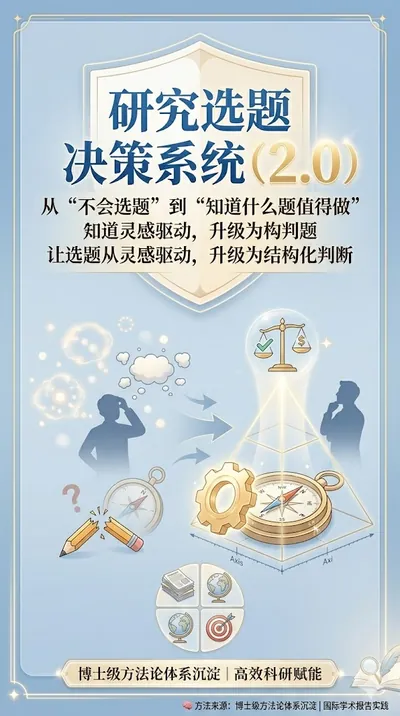
Research Topic Decider (2.0)
From inspiration to structured topic judgment.
Research Topic Decider (2.0)
From inspiration to structured topic judgment.
Showcase
Description
Do you also face these problems? 1. You have many ideas but don't know which can become a paper. 2. Halfway through, you realize the topic has no value and can't be published. 3. Others can publish anything, yet you're always stuck on topic selection?! 4. You're always torn between 'feels right' and 'actually not good'... 👉 The real issue isn't that you can't write, but that you can't judge whether a topic is worth doing!!! 🧠 What does this system solve for you? 1. Help you filter out truly worthwhile topics from a pile of 'seemingly okay' ideas. 2. Help you avoid overcrowded red-ocean research. 3. Help you find directions that are easier to publish and can form a research thread. 4. Help you turn 'topic selection by gut feeling' into 'logical judgment'. ⚙️ How does it work? Just input a vague idea, like 'AI applications / Teacher development / Classroom management' The system will do four things for you: 📍 Reality check: Is this issue really important? 📊 Academic check: Has it been overdone? ⚔️ Competition check: Do you still have a chance to win? 🎯 Self check: Do you have an advantage in this direction? 🚀 What will you get in the end? A 'research sweet spot' (the essence of a truly worthwhile research problem) 3 topic options (safe / publishable / breakthrough) A clear judgment: Should you do this topic or not? 🧠 Who is this for? People who want to publish papers but are stuck on topic selection. People who want to apply for research projects but don't know where to start. People who no longer want to waste time on 'ineffective research'. Researchers who want to go from 'following' to 'judging'. 📌 One-sentence summary It's not about thinking of more topics, but about reducing 90% of research that isn't worth doing! 🧠 Methodology Source This system is built on a methodology system distilled by PhD-level researchers, continuously optimized through national and international academic presentation practices and provincial/ministerial-level research project experience.
Related Skills
View all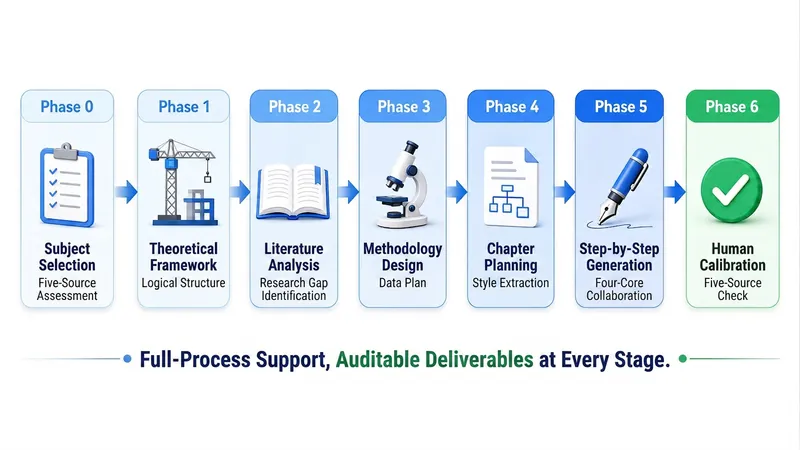
Proposal Readiness Checker
Before you spend dozens of hours writing your thesis, take ten minutes to run a structured checkup. This skill does only one thing: It diagnoses, not writes. It tells you whether your topic can hold up, whether your materials are sufficient, what's missing, where to fill the gaps, and in what order. Then it gives you an actionable missing-material checklist and search queries. It will not write your introduction, literature review, methods, or discussion. Four steps: 1. Discipline diagnosis: Classify your work into 1A Humanities/Arts, 1B Social Sciences, 2A Science/Engineering, or 2B Agriculture/Medicine/Life Sciences, and load the corresponding regulatory red lines; 2B triggers a mandatory ethics review block. 2. Topic checkup: Examine the topic from three dimensions—momentum, shape, and wording—to judge whether the research unit can be operationalized, whether the research question can be answered, and whether the topic has been done to death. 3. Material checkup: Register your existing literature into an M1/M2… material library, verify each entry against the four elements (author/year/title/verifiable locator), and compute the true coverage rate. 4. Gap list and search queries: Specify how many papers of what type are missing and which piece of evidence is lacking, and provide search queries ready to paste into databases (including Boolean keyword combinations, time ranges, and screening criteria). When to use it (trigger phrases): "Help me check my proposal" "Can this topic work?" "Do I have enough literature?" "My proposal was sent back" "I want to confirm before starting to write" — for graduate students who have just set a direction but haven't started writing; for those whose proposal was rejected but don't know why; for those with a pile of literature but unsure if it's enough to begin; for those wanting to confirm whether the topic is worth the investment before committing fully. Deliverables: A Proposal Checkup Report document + a Five-Source Readiness Scorecard (each level has behavioral criteria, not vague scoring) + a prioritized list of missing materials + search queries + an archive code. The archive code is compatible with the Academic Paper Full-Process Writing System v4.0; after the checkup, paste it there to continue writing without re-stating your discipline, topic, or journal. What this skill explicitly does not do: It does not write the main text, generate reference lists, or fabricate authors, years, volumes, issues, pages, or DOIs. Any literature found via online search is flagged with ⚠️ "needs verification" and must be verified by you before use. This skill does not promise any acceptance or passing outcome.
Management Paper Strict Review
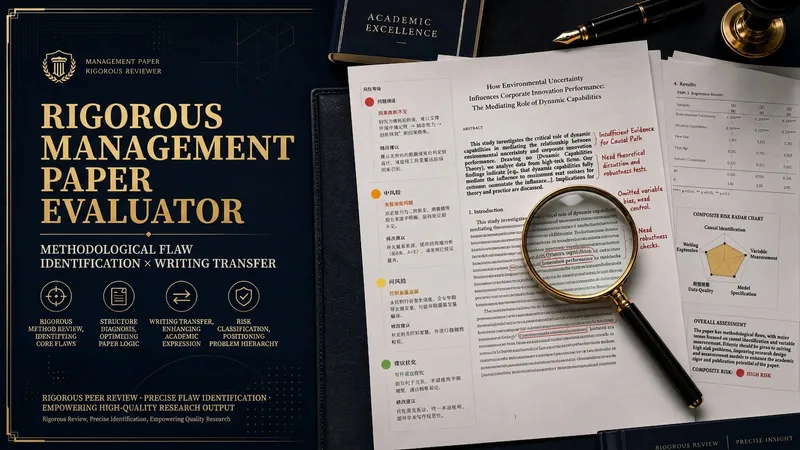
Have you encountered these problems? ❌ You cited a seemingly authoritative paper, only to have reviewers question, 'This study has severe endogeneity issues.' ❌ When writing a literature review, you're unsure whether a paper's conclusions are trustworthy. ❌ After reading dozens of papers, you still don't know how to apply others' writing techniques to your own paper. ❌ Before submission, you want to check for methodological risks but don't know which hard flaws top journal reviewers focus on. This Skill helps you: ✅ Quick mode (15–25 min): Determine whether a paper is worth reading in depth and can be cited confidently. ✅ Deep mode (45–60 min): Check methodological flaws item by item like an AMJ/ASQ/SMJ reviewer. ✅ Quantitative credibility rating: 🔴 Not citable / 🟠 Use with caution / 🟡 Reference only / 🟢 Safe to cite – at a glance. ✅ Writing transfer task card: Turn techniques from others' papers into executable tasks for your own Introduction/Methods/Results/Discussion sections. Covers seven methodology types: Quantitative regression, experimental studies, quasi-experimental causal identification, fsQCA, case studies, grounded theory, mixed methods. Output includes: - Six-area deep reading (theoretical dialogue, mechanism pathways, construct operationalization, method-data fit, contribution critique, writing techniques) - P1/P2/P3 risk levels (fatal/important/arguable) - Counterfactual testing (can the model explain reverse scenarios?) - Boundary condition check (5 dimensions: market/regulation/capital/technology/competition) - Writing transfer task card (specific techniques directly applicable to your own paper) In a nutshell: It is not a gentle paper summarizer. It's a strict academic writing assistant that helps you discover, 'Where can't this paper be trusted? What is worth learning from it? How can I apply it to my paper?' Suitable for you if you are: 📚 PhD/master's students writing literature reviews 📝 Management researchers preparing submissions to top journals 🔍 Reviewers needing quick paper quality assessments 📖 Paper writers wanting to learn top journal writing techniques
MOE Counselor Review v2.4.0
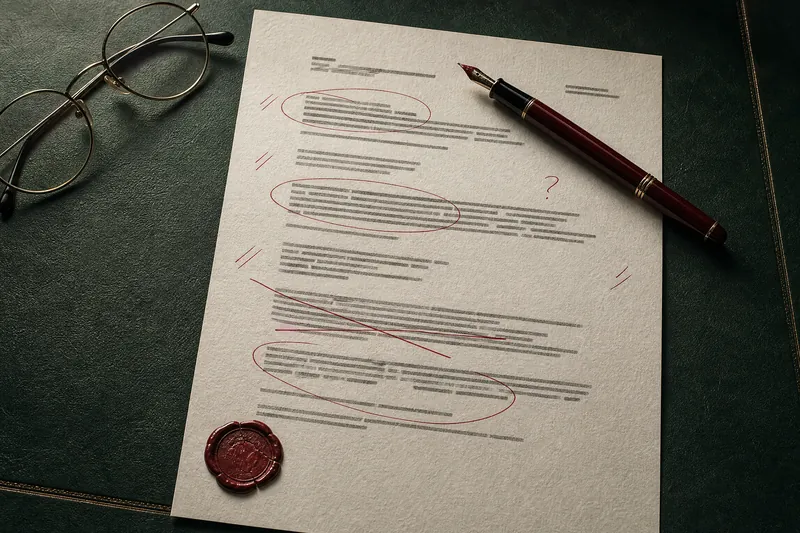
This Skill does not write your application for you; instead, it pre-screens the questions the review panel would ask: whether your identity is compliant, whether the project limit is violated, whether the research question withstands a one-sentence challenge, whether the research approach collapses by the second paragraph — each item turned into an actionable revision checklist. It incorporates the original text of the 2026 edition of 90 key research directions and 7 clusters of implicit weight tables, and is grounded in the risk map of previous years' special project reviews. Annual hard constraints such as document number, funding amount, research period, submission limit, etc., are verified by default against the current year's official notice — no hardcoding. ## What it does - Formal compliance hard check: identity as full-time counselor, submission limit, funding amount, research period, and other knockout gates (annual parameters based on the current year's official notice) - Sequential referencing diagnosis: for the 「(Reliant Direction N)」 at the end of the title, perform item-level compliance check — sequence validity + three-tier direction-title alignment (strong / moderate / weak) + cluster-level risk warning - Research question stress test: use 「So what?」 and 「What exactly is the difference from existing research?」 as two knives to pre-screen for the review panel - Research approach reverse deconstruction: mark paragraph by paragraph 「how this will be questioned」 rather than 「this is well written」 - Innovation authenticity diagnosis: which of 「first / systematic / breakthrough / fill a gap」 would be debunked by a literature search - Actionable revision checklist: prioritised next steps ## What it does not do - It does not choose your topic for you - It does not generate the application body - It does not 'polish' language - It does not tell you 'this topic is valuable' — no one on the review panel will compliment you like that ## How it differs from similar tools Other project review Skills on the platform assume you are applying for the National Social Science Fund or MOE general projects — the funding amounts, project limits, and identity requirements are all wrong. If you use them, your application will be revised against the wrong standards. This Skill is currently the only reverse review engine on the marketplace specifically for the 'MOE College Counselor Research Special Project', and it incorporates the original 2026 edition of 90 guidelines + 7 clusters of implicit weight tables; the 2025 edition is retained as a historical version, and cross-year applications can use 'sequential referencing diagnosis' for alignment. ## Who it is for - Full-time college counselors preparing to apply for the 2026/2027 MOE Counselor Research Special Project - Heads of student affairs departments (compliance gate before school-level preliminary review) - Applicants who have finished a draft and want the most critical eye to review it again ## Who it is not for - Those who want to generate an application with one click - Those applying for the National Social Science Fund or MOE general humanities and social science projects (please use the corresponding general Skill) - Those who haven't started writing yet — reverse review requires an object to review Version: v2.4.0 | Incorporated 2026 edition of 90 guidelines original text + 7 clusters classification + sequential referencing diagnosis | Annual hard constraint parameters subject to official notice ([Document Number Pending]) | Review engine has undergone multiple rounds of stress testing and retrospective upgrades
Information
- Version
- v2
- Last updated
- Runtime credits
- Usage-based
- Models
- Auto