Project DNA Extractor
Project DNA Extractor
Showcase
Description
Extract the core essence of the entire project, outputting a knowledge base DNA and seed information for disaster recovery reconstruction.
Related Skills
View all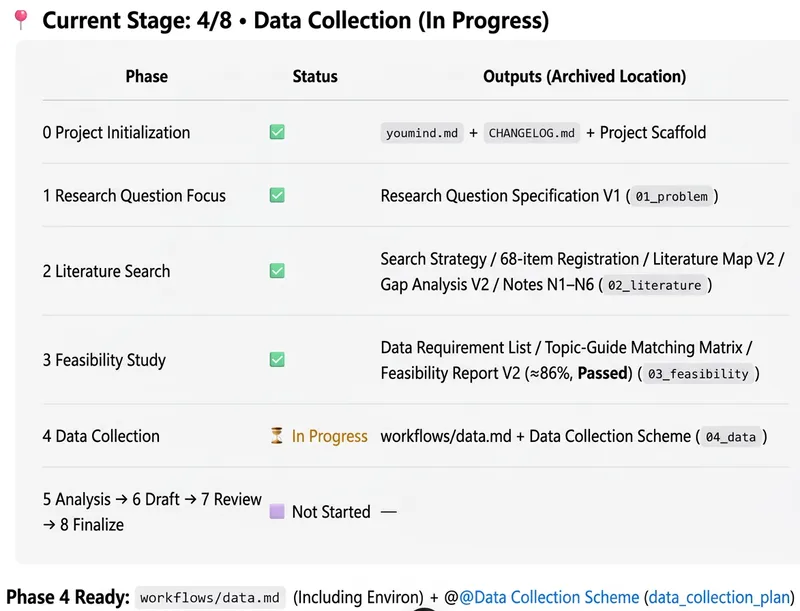
Research Proposal Assistant
Designed for university faculty and researchers, this assistant turns an initial research idea into an executable, fundable project plan. It covers national- and provincial-level humanities and social sciences projects, teaching reform projects, and other research project types. Provide the project type and application guidelines or template, research direction, existing成果, and personal and institutional information. The assistant helps clarify the topic, focus the research question, and build a complete foundation for the proposal around the research problem, application requirements, and review logic. As the project develops, the assistant can support academic searches, literature reviews, research gap analysis, feasibility assessments for data and methods, comparable project matching, and research design adjustments. It helps ensure that literature, data, and funding information are authentic and verifiable, while incorporating AI, contemporary relevance, and methodological innovation into the topic and innovation points. Once the research plan is mature, it can draft an initial proposal based on the application guidelines or blank template you provide, simulate different reviewer perspectives, and suggest revisions through to the final draft. The project retains stage outputs, version records, and the basis for changes. It can ultimately organize a proposal, technical roadmap, research framework diagram, innovation logic diagram, progress Gantt chart, and other research visuals. For tasks requiring an external environment, such as full-text PDF analysis, code execution, web scraping, or large-scale data processing, the assistant clearly identifies handoff tasks and supports filling in results and continuing the work, helping move the project from preparation through a properly formatted final proposal.
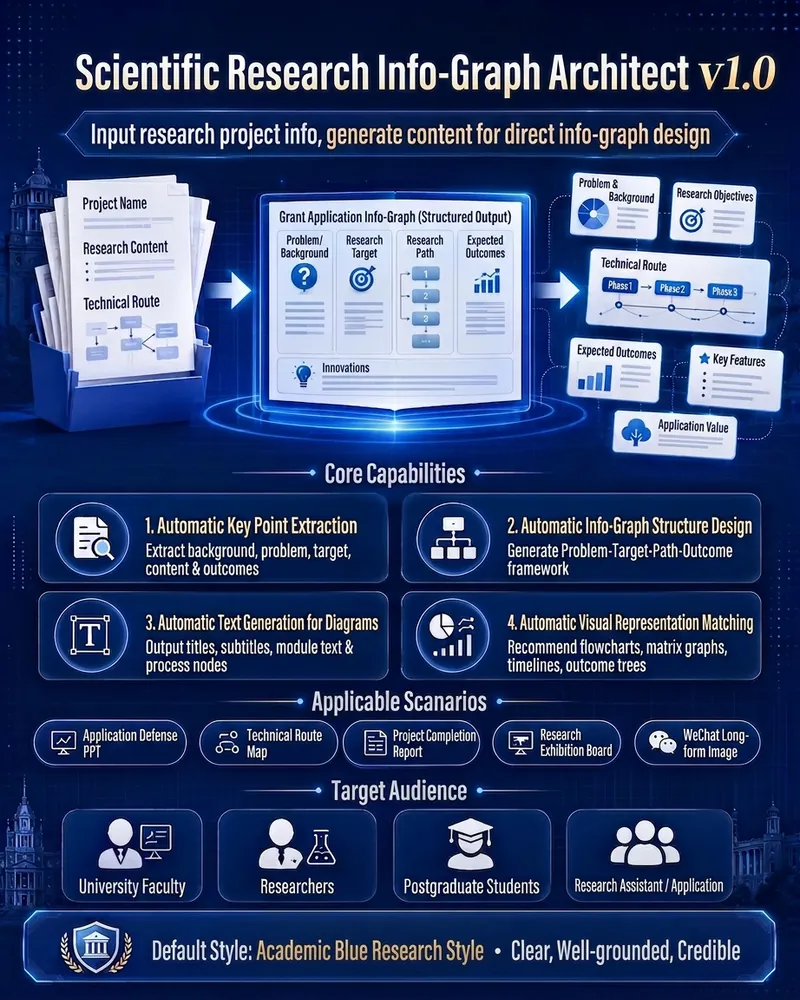
Grant Infographic Architect v1
Turn complex research grant application content into a clear, professional, and compelling infographic. It helps you: 1. Automatically extract key points for visualization From project title, research background, research questions, objectives, content, technical approach, and expected outcomes, extract the key information best suited for visualization. 2. Automatically design the infographic structure Based on the project type, generate an infographic framework of "Problem – Goal – Path – Results – Value" to avoid content clutter and logical confusion. 3. Automatically generate in-graphic text Output titles, subtitles, module headings, short copy, process nodes, result tags, chart descriptions, etc., ready to hand off to designers or use in PPT creation. 4. Automatically match visual expressions Suggest suitable graphic forms for each module, such as flowcharts, path diagrams, matrices, timelines, pyramids, four-quadrant charts, result trees, result maps, etc. Suitable for: University faculty, researchers, graduate students, project leaders, research secretaries, project application teams, and academic PPT creators. How to use: Simply enter the project title, research topic, or paste a portion of application materials. You don't need to organize the format beforehand; the system will automatically identify key information and generate a research grant infographic plan. If the materials are incomplete, it will generate a usable version first and ask 1–3 key questions as needed.
Better Organize for Projects
Organize scattered project materials into structured index documents with support for incremental updates. Automatically identifies material types and extracts core information. FYI: If the organization involves many materials, it may consume more credits.
Information
- Version
- v2
- Last updated
- Runtime credits
- Usage-based
- Models
- Auto
- Capabilities
- Web research
