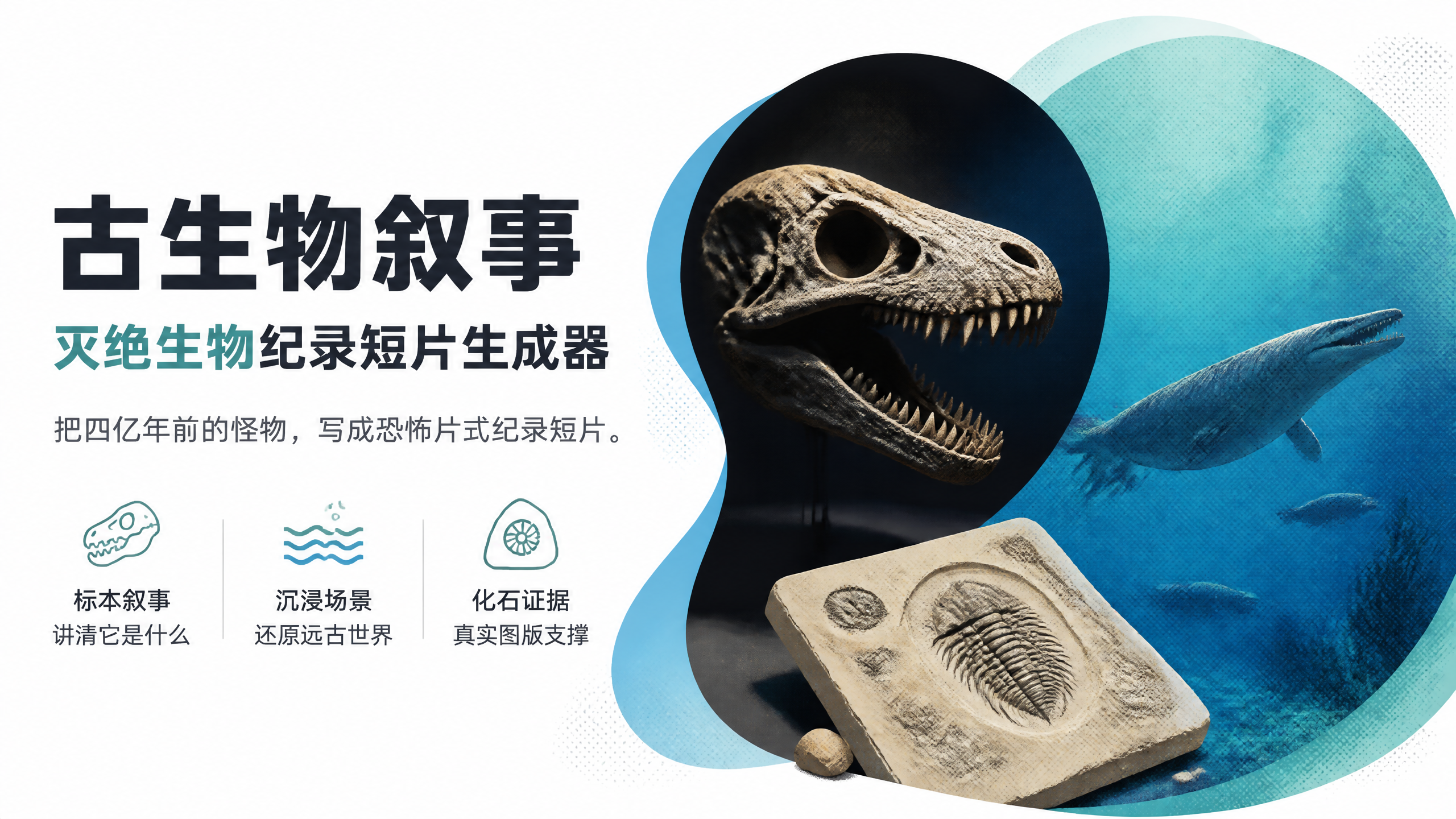
Paleo-Horror Short Generator
Turn ancient creatures into horror-style shorts.
Paleo-Horror Short Generator
Turn ancient creatures into horror-style shorts.
Showcase
Description
Write a 6-8 minute horror-documentary short about an extinct creature: black-background specimen shots to explain 'what it is,' blue-green underwater shots to explore 'what happened back then,' and real fossil plates as evidence. The script opens with lines like 'You think A is scary? Its ancestors would just pray it wasn't hungry,' bringing deep time home to the audience every 90 seconds. Ideal for science short films on paleontology, evolutionary history, and extinction events. Triggers when users mention 'paleontology,' 'extinct animals,' 'prehistoric beasts,' 'evolutionary history science,' or 'fossils.' Not suitable for: live macro insect footage (use macro insect life), 3D cartoon or claymation styles (use stop-motion/3D shorts), pure academic restoration illustrations, or paleogeographic campaign simulations requiring precise maps (use topographic narrative).
Best for
Content creators and educators producing science short films on paleontology, evolutionary history, and extinction events.
How to use this Skill
Provide your input
Enter an extinct creature, evolutionary milestone, or extinction event along with known facts, fossil evidence, or target theme.
Run the Skill
Organizes the topic into a horror-style documentary short film proposal, combining narrative, storyboard, narration, visual, and sound design.
Review your result
Receive a complete 6-8 minute script and production plan including storyboards, visual cues, evidence presentation, and compliance tips.
Related Skills
View all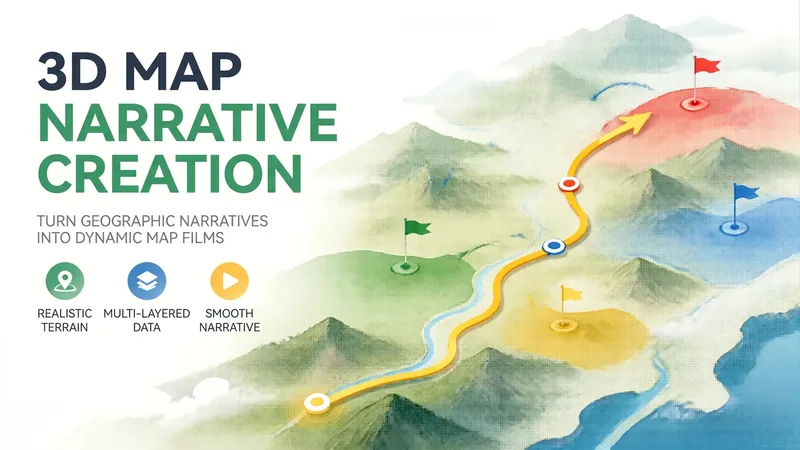
3D Map Event Generator
Turn geographically progressive events—such as military campaigns, expeditions, retreats, plague diffusion, or engineering routes—into 6-10 minute 3D satellite map narrative videos. Built on real terrain screen recordings with five-color layers (red, cyan, blue, green, yellow) representing factions and paths, featuring a single main route and smooth camera zooms instead of hard cuts. Designed for historical geography commentary, military simulations, and documentary-style popular science. Triggered when users mention "3D map", "map simulation", "campaign review", "map storytelling", or "route commentary". Not suitable for: single static terrain science graphics (use 3D terrain science), ancient-style maps (use historical maps), fictional dramas requiring character dialogue and acting (use film storyboards), or pure data charts.
 Image
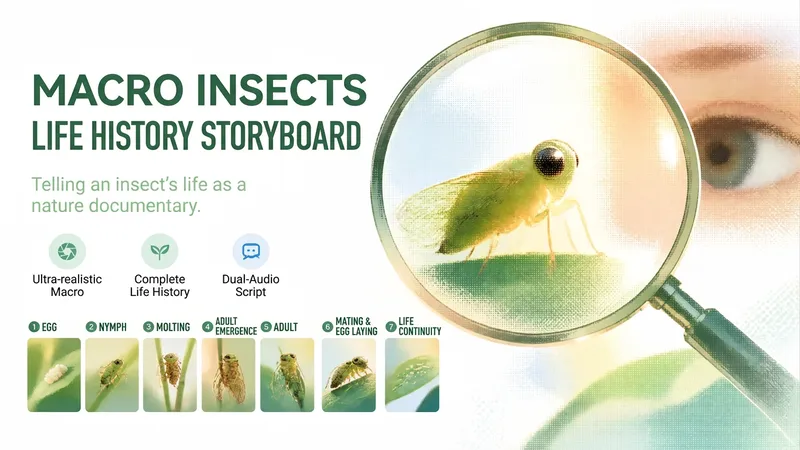
Macro Insect Life Storyboard
Generate hyper-realistic macro storyboards of insect life histories, featuring shallow depth-of-field background blur, backlit golden rims, and a dark spot in the center of compound eyes forming a lively look, with anthropomorphic poses yet accurate anatomy. Includes a seven-act life history framework and a dual-audio script method featuring fact-based narration and inner-monologue reflections. Suitable for storyboards and illustrations in insect and small creature science short films, such as the life cycles of cicadas, butterflies, mantises, dragonflies, and snails. Triggered when users mention "macro insects," "an insect's life," "nature documentary storyboard," or "video like that cicada clip." Not suitable for specimen-style flat lays without blur or emotion, large animal or human subjects, precise Chinese text within the image, or pure cartoon characters.
 Video
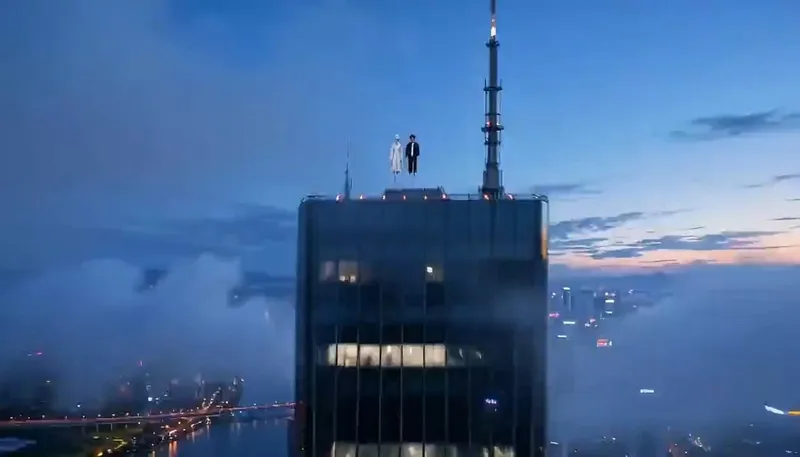
Deep Time Guide
Turns the 4.6-billion-year history of the Earth into a 3.5-minute two-person dialogue style space-time documentary featuring an omniscient non-human guide and an ordinary person asking questions on behalf of the audience. Connects multiple eras through the action of stepping into the next era, with a question-and-answer exchange every 3 seconds, translating grand scales into everyday metaphors and finally landing in the present. Outputs include two-person character concept prompts, era scene prompts, a 56-shot storyboard table, image-to-video camera movement prompts, subtitle specifications, and background music guidelines. Trigger words: Earth history, 4.6 billion years, life evolution, deep time, time-space travel documentary, guided popular science, AI science video, knowledge short video, two-person dialogue, era travel. Not suitable for: science educational films requiring professional narration voiceovers, single-person talking-head videos, pure stock footage compilations, or popular science animations (this skill produces a realistic live-action texture throughout).
Information
- Version
- v3
- Last updated
- Runtime credits
- Usage-based
- Models
- Auto
- Use cases
- Images & designVideo & audioLearning & education
- What you get
- ScriptPromptPlan
- Visual styles
- Cinematic
