Automated Literature Review
Automated Literature Review
Showcase
Description
Write reviews like a seasoned scholar. Zero external knowledge, strict source attribution, automatically identifying controversies and gaps to distill genuine insights from vast literature.
Recommended by
nene@YouMind
Why we love this skill
This skill is a powerful assistant for academic researchers, automatically generating detailed or concise literature reviews from provided documents. It strictly follows academic standards with APA 7th citations, conflict markers, and research gap analysis, ensuring professionalism and depth to greatly improve research efficiency.
Related Skills
View all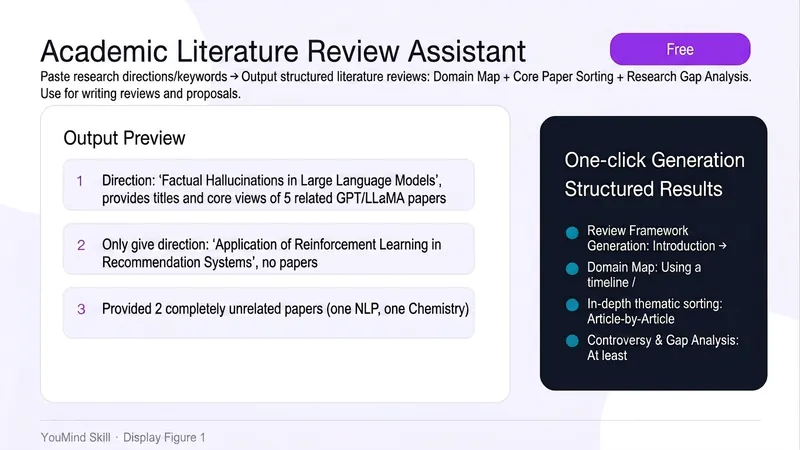
Literature Review Assistant
Writing a literature review is an inevitable challenge for graduate students—but turning information from 50 papers into a logically structured review, rather than a mere summary list, relies on methodology, not brute force. Tell it your research direction and the core papers you've already read. It first builds a framework—field map, thematic sorting, debates and gaps—then, after your confirmation, helps organize the language chapter by chapter. It doesn't write the paper for you, but helps you present the papers you've read with academic logic. ✨ Core Capabilities 1. Review framework generation: Introduction → Field map → Thematic sections → Debates and gaps → Outlook, standard academic structure 2. Field map: Sort domain development by timeline/school of thought, highlight milestone papers 3. In-depth thematic analysis: Individual paper introduction + intra-group comparison + overall contributions and limitations 4. Debate and gap analysis: At least 3 points of debate + 3 research gaps, with specific literature sources 5. Academic writing norms: Citation format, bilingual terminology, critical language rather than mere description 📱 Use Cases - Literature review chapter for graduate thesis/proposal writing - Related Work section of journal papers - Quick literature overview + structured notes when entering a new field - Used in combination with "论文速读笔记" and "论文双模研读" to form a "Read → Analyze → Synthesize" literature workflow ⚠️ Note: This skill does not perform real-time academic search. You need to provide information on papers you have already read (title/author/key points), and it helps you organize and write.
Econ & Mgmt Review Assistant
Analyze academic literature like a top business and economics scholar. From methodology to theoretical frameworks, precisely identify research gaps to help you quickly write high-level reviews that meet top journal standards.
 Research
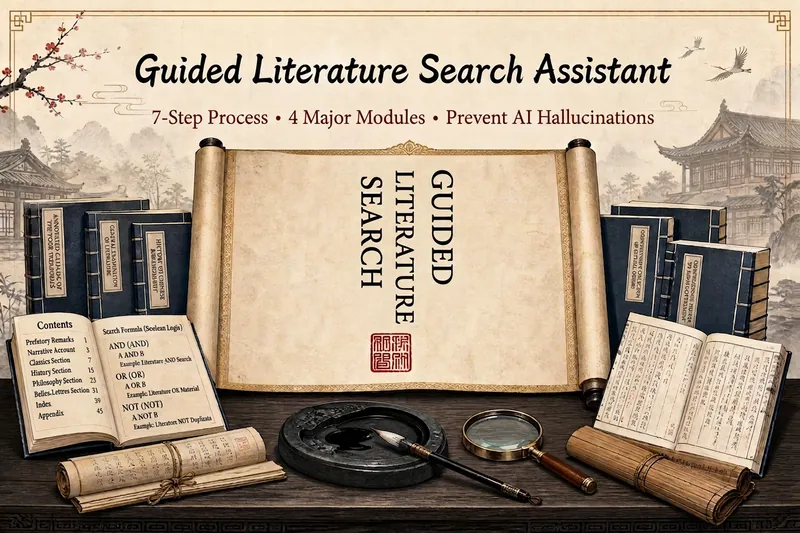
Guided Literature Search
Search literature differently: this Skill gives you a “map of the field” first. It offers five standout capabilities: ① Reviews first, core papers second (a strict rule)—find 3–5 review articles to map the field, then follow their references to locate core literature, so you are not overwhelmed by hundreds of papers from the start; ② Literature authenticity verification (to prevent AI hallucinations)—uses placeholder-pattern checks and real-time verification through CrossRef, DOI, CNKI, and Wanfang, checking each author, journal, DOI, and page number without fabricating a single reference; ③ Automated advanced CSSCI searches on CNKI—when you have VPN or institutional access, automatically extract CSSCI records and abstracts, up to 100 papers at a time, and save them directly to Excel; ④ Direct English OA downloads—download directly from arXiv, MDPI, Frontiers, and other sources at 100%; download approximately 50–70% of Springer and Elsevier OA papers directly; for paywalled papers, receive a DOI link and VPN download instructions; ⑤ Topic selection with the Three-Circle Focus Method—intersect policy trends, your prior experience, and your problem awareness to turn a vague idea into a genuinely worthwhile research topic. The seven-step core workflow is: research topic design → keyword refinement → find reviews first → find core literature → screen and verify → attempt downloads → produce a prioritized reading list. It also includes two enhanced modules: a structured 12-element breakdown in Excel and iterative reflection after reading. Clear boundaries: it does not promise to bypass CNKI’s anti-scraping protections to download Chinese full texts, log in to a VPN on your behalf, or write the main body of your paper. Designed for graduate students, university faculty, and academic researchers who need to conduct systematic literature searches.
Information
- Version
- v1
- Last updated
- Runtime credits
- Usage-based
- Models
- Auto