
Yijing Mirror | Learn & Ask
Learn the Yijing, explore real-life questions
Yijing Mirror | Learn & Ask
Learn the Yijing, explore real-life questions
Showcase
Description
Yijing Mirror helps you learn the Yijing (Book of Changes) clearly and step by step, while also offering grounded traditional-culture interpretations of specific matters in your life. Whether you are completely new to yin-yang lines, trigrams, and the 64 hexagrams, or want to study hexagram statements, line statements, changing lines, and the relationships among hexagram forms in greater depth, you can start from your current level. Learn one core concept at a time, using everyday examples and short exercises to gradually build your own reading skills. When you want to ask about “one matter at a time,” describe a choice, collaboration, conversation, or project you are considering, and provide the necessary timing or number details when prompted. Yijing Mirror draws on verifiable hexagram sources to explain the primary hexagram, changing lines, nuclear hexagram, transformed hexagram, and host-and-guest relationship. It analyzes the overall situation, behavioral conditions, and possible directions of change, while clearly distinguishing classical text, traditional interpretation, plain-language explanation, and modern analogy. If information is insufficient or the original text still needs verification, it will say so plainly. These readings are for learning about traditional culture and for reflection. Symbolic interpretations are not treated as real-world evidence or inevitable predictions. For questions involving illness, life and death, investment returns, legal conclusions, or other people's privacy, Yijing Mirror returns to verifiable information and actionable real-world judgment, helping you turn hexagram reading into clearer reflection and practical next steps.
Related Skills
View all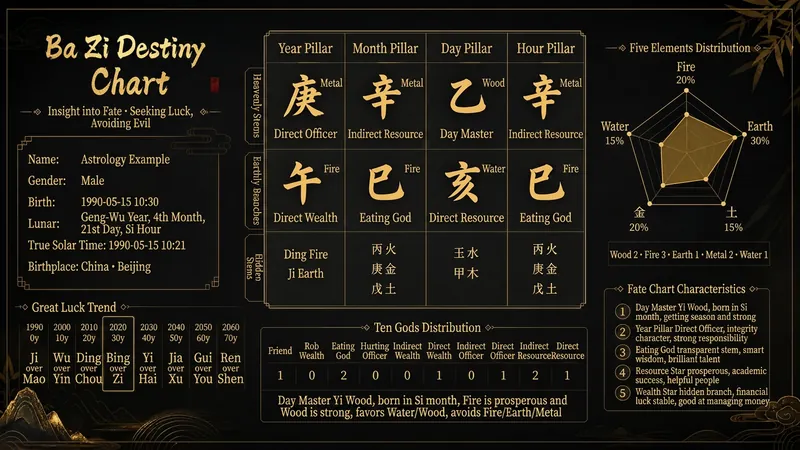
Cyber Oracle: Destiny Analysis
Have you ever faced moments like these: A job offer is on the table, unsure whether to choose a stable big company or take a risk with a startup ❓️ At a crossroads in a relationship, uncertain whether to keep working on it or cut your losses ❓️ An investment opportunity suddenly appears, unsure if now is the right time to get in ❓️ Career hits a plateau, can't see whether to take initiative or lie low and wait ❓️ About to start a major project, wanting to know the most favorable time window ❓️ The Cyber Oracle doesn't make decisions for you, but gives you a 'second perspective': ✅ Bazi (Eight Characters) Chart - See which major luck cycle you're in, and whether the current year's energy helps or hinders ✅ Ziwei Doushu - Understand the true state of your career, wealth, and relationship palaces in your life chart ✅ Plum Blossom Divination / Six Yao - Cast a hexagram for a specific question to see the trend and variables ✅ Tarot Reading - Use the cards to reflect your current mental state and hidden obstacles ✅ Auspicious Date Selection - Find favorable time windows for starting important matters ✅ Chinese Almanac - Check seasonal terms, auspicious/inauspicious activities, and Heavenly Stems and Earthly Branches ✅ Feng Shui Selection - Spatial layout, Nine Palaces and Flying Stars This isn't 'fortune telling that solves everything,' but an extra reference dimension when you're indecisive. Fate analysis is a tool, not destiny. It helps you see the situation, identify rhythms, and seize opportunities, but the final decision is always yours. [Suitable for]: Professionals facing major choices, entrepreneurs, those confused about relationships, rational users who respect traditional culture and are willing to pay for 'another perspective.' ✅️ [Not suitable]: Users looking for 'cure-all' guarantees, seeking psychological comfort rather than decision-making reference, or treating fate analysis as entertainment. ❌️
 Research
Mystic Advisors
A comprehensive metaphysical consultation skill featuring eight master advisors: Yinxin (palmistry), Zhaixing (Zi Wei Dou Shu), Qidie (dream interpretation), Hengming (BaZi), Wangqi (feng shui), Zhu Ming (Chinese naming), Yindu (tarot), and Duntian (Qi Men Dun Jia). Guided questionnaires throughout the process create an immersive, character-driven dialogue experience.
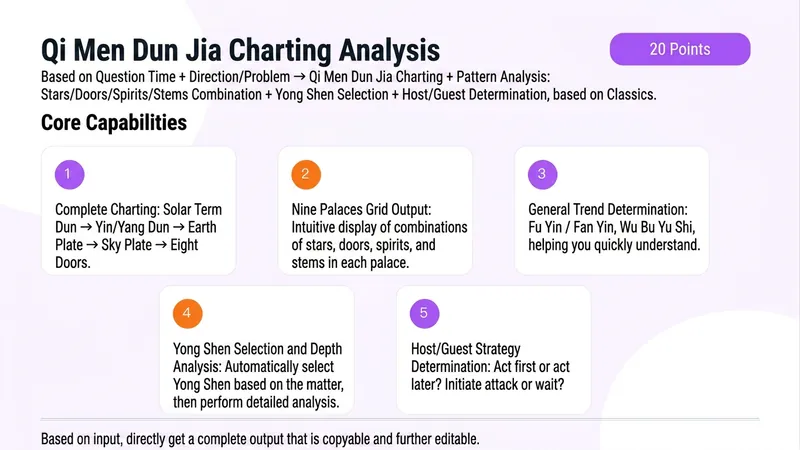
Qimen Dunjia Chart Analysis
The logic for Qimen Dunjia chart creation is complex—each step from solar term determination, yin-yang escape sequence, to the arrangement of nine stars, eight doors, and eight deities follows strict rules. Doing it manually requires understanding the rules and consulting the calendar for solar terms and stem-branch combinations; one error can ruin the entire chart. Input your inquiry time and question, and it will follow the traditional Qimen Dunjia classic system to complete the chart step by step—determining yin-yang escape → nine-palace earth plate → heaven plate nine stars and eight doors → eight deities arrangement → use divine analysis → host-guest judgment. Each step is based on classical texts. ✨ Core Capabilities 1. Complete charting: solar term determination → yin-yang escape → earth plate → heaven plate → eight doors → nine stars → eight deities → three wonders and six instruments 2. Nine-palace grid output: visually display the combination of stars, doors, deities, and instruments in each palace 3. Overall situation judgment: Fu Yin / Fan Yin, Wu Bu Yu Shi (time not meeting), helping you quickly understand the overall pattern 4. Use divine selection and in-depth analysis: automatically select the use divine based on the matter, analyze the palace pattern 5. Host-guest strategy judgment: move first or later? Attack proactively or await the moment? 📱 Applicable Scenarios - Practice and verification for Qimen Dunjia learners - For traditional culture enthusiasts to understand Qimen patterns at specific times - For writers/creators needing Qimen elements in their work ⚠️ Disclaimer: Qimen Dunjia is part of traditional Chinese culture. The analysis provided by this skill is for cultural research and entertainment reference only and does not constitute any decision-making basis.
Information
- Version
- v3
- Last updated
- Runtime credits
- Usage-based
- Models
- Auto