
AFP Family Insurance V2.0
Risk & insurance framework, not product recs
AFP Family Insurance V2.0
Risk & insurance framework, not product recs
Showcase
Description
Based on the AFP family life cycle model, it builds a family risk profile through 3–5 progressive questions and generates a structured insurance protection plan, achieving a professional-grade planning tool that shifts from product recommendation to family risk structure design.
Related Skills
View all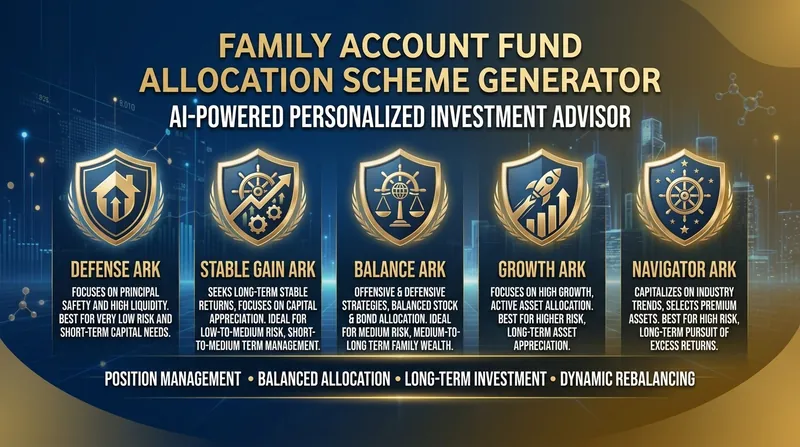
Family Portfolio Plan Generator
A professional family wealth management advisor skill that provides personalized fund investment allocation plans based on client information such as age, income, investment period, expected return, and risk tolerance. It adopts the concepts of 'position management, balanced allocation, long-term investment, dynamic balance', matches five strategy systems, and generates allocation plans covering 9 asset packages.
 Research
Course Designer V2.0 AFP
Based on the AFP (Auto-Flow Prompt) framework and a dual-core engine, it uses fine-grained Step-Lock workflows to help university teachers design a complete professional course from scratch. v2.0 incorporates the meta-principles of the 'Ten Laws of Instructional Design', solidifying concept-level rules such as era anchoring, carrier ensoulment, three stages of sublimation, and theme linking into Core_B audit red lines, ensuring that outputs are not just format-compliant lesson plans but lessons with soul.

AFP Engineered Prompt Generator
AFP Engineered Prompt Generator · Master-Level System Architecture 🎯 Core Positioning: A meta-level prompt engineering system — used to generate foundational architecture for other AFP domain skills. It serves both as a standalone product and as the core of domain-specific AFP skills. 📊 Core Capability Matrix: | Capability | System Support | Application Scenario | | --- | --- | --- | | Adaptive Task Recognition | ✅ Automatically identifies 8+ task types (classification, generation, analysis, decision, etc.) | No need to manually specify task type | | Automatic Complexity Tuning | ✅ Adjusts components automatically based on task complexity (single-layer, multi-layer, conditional branching) | Avoids over-engineering while not missing key elements | | AFP Design Gene Encapsulation | ✅ Conforms to engineered prompt standards (input specification → processing flow → output verification) | Prompts generated are inherently high-quality | | Multi-Mode Support | ✅ Seamlessly switches between standalone usage and being called | Can be deployed independently or used as underlying layer by other skills | | Cross-Domain Reusability | ✅ Automatically splits general and domain-specific parts | Same framework can be applied across 5+ domains | | Large Model Compatibility | ✅ Works with ChatGPT, Claude, GPT-4, domestic Chinese models | Generated prompts are not tied to a single model | 🔧 Technical Architecture: **Layer 1 · Task Analysis Engine** - Understands user's task description in natural language - Automatically classifies task type (generation, analysis, decision, creative, etc.) - Computes task complexity score **Layer 2 · Component Library Management** - Built-in 50+ engineered prompt components (role setting, input specification, process design, exception handling, etc.) - Tagged by complexity level (L0 simple / L1 medium / L2 advanced / L3 expert) - Supports selective assembly and custom expansion of components **Layer 3 · AFP Framework Generation** - Organizes prompt structure following AFP design gene (function layering → process orchestration → output formatting) - Automatically generates complete instruction chain - Built-in quality inspection (coverage, redundancy, consistency checks) **Layer 4 · Output and Integration** - Generates plain text prompts (ready to use) - Generates structured configuration files (callable by programs) - Supports version management and iterative optimization 📈 Expected Effect Metrics: | Metric | Improvement | Description | | --- | --- | --- | | Prompt design cycle | From 1-2 weeks → 10-30 minutes | From manual design to automatic generation | | Output quality stability | From 70-80% → 85-92% | Engineered design is inherently more stable | | Cross-domain reuse rate | From 30% → 80%+ | General and special parts are automatically separated | | Team learning cost | From 3-6 months mastery → 1-2 weeks onboarding | New members can quickly reuse quality frameworks | | Large model migration cost | From full rewrite → partial fine-tuning | Framework is stable, model upgrades don't require major changes |
Information
- Version
- v3
- Last updated
- Runtime credits
- Usage-based
- Models
- Auto