Economics Paper Review (V3.1)
Economics Paper Review (V3.1)
Description
A deeply customized Skill designed specifically for reviewing economics papers, entirely AI-powered, no local scripts required. Automatically identifies paper type and research strategies (DID/IV/RDD, etc.), uses a four-pass scanning method (Three Fundamental Questions → Identification Strategy → Econometric Techniques → Language Layer) to produce high-density professional reviews. At least 1 review per 400 words, with an estimated 50-100 reviews for empirical economics papers. Suitable for pure web-based use.
Related Skills
View all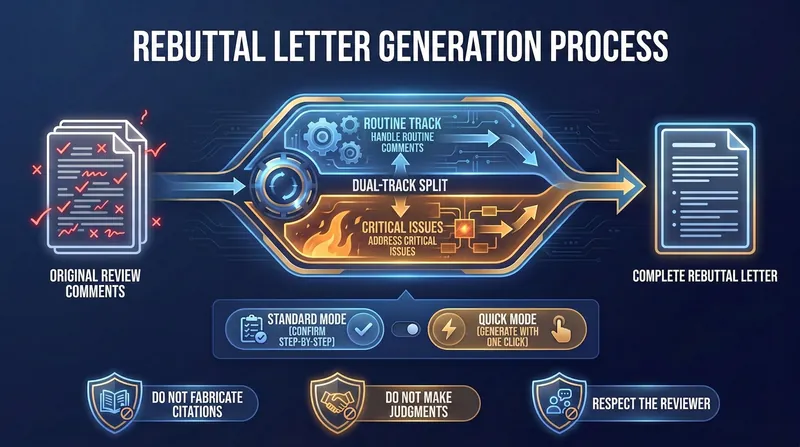
All-in-One Review Response V3.0
A full-process system for responding to peer review comments in social sciences and economics/management academic papers — from comment analysis, strategy formulation, and hard flaw defense to one-click assembly of a Rebuttal Letter. V3.0 Core Upgrades: · Governance layer: unified dashboard + 3 step modes (Standard/Fast/Slow) + ratchet version management + mid-process join logic · All 12 quick commands implemented (/quick /jump /skip /rerun /export /resume /tone /hardcase /conflict /cover /draft /lang) · Cross-step comment tracking table: tracks the status of each comment from Step 1 to Step 6 for closed-loop management · Complete library of 7 hard flaw diagnostics + subfield adaptation (Accounting/Finance/Management/Marketing/Labor Economics/Macroeconomics/Qualitative Research) · Full language pair support: Chinese→English / English→English / Chinese→Chinese, with automatic detection of review comment language · New revision Cover Letter generation + summary table of changes · Tone calibration system upgrade: forbidden expression list (20 items) + auto-correction + politeness score · Enhanced safety boundaries: anti-hallucination citation check + anti-overpromising check + AI-generated content transparency statement Applicable scenario: One-stop response writing for PhD students and early-career researchers in social sciences and management after receiving review comments.
Grant Proposal Review PRO V2.0
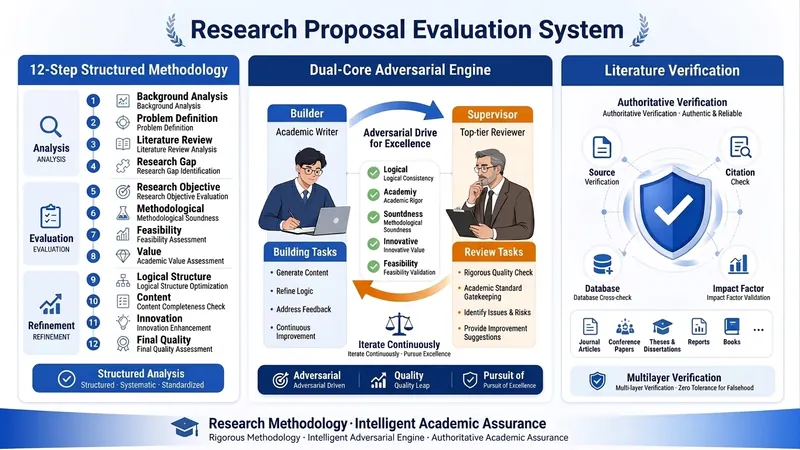
🎯 Core Functionality Overview This is an intelligent review and optimization system specially designed for national social science, education ministry, and provincial grant applications. It simulates the thinking mode of a senior review expert with 15 years of experience, ensuring academic rigor and competitiveness through three core mechanisms. 🔧 Three Core Mechanisms 1️⃣ 12-Step Structured Methodology Covers the full lifecycle of grant proposal review: Phase 1-3: Basic Diagnosis - In-depth analysis of announcement (funding priorities, review criteria, application requirements) - Cross-disciplinary type judgment (precise identification of 8 types) - Research GAP five-dimension identification (theory/methodology/empirical/policy/technology) Phase 4-7: Core Element Review - Research question TMAQ model analysis (theory/methodology/approach/question four dimensions) - Research objective SMART principle test - Research content framework completeness assessment - Research approach type matching (6 types) Phase 8-10: Deep Quality Enhancement - Precise extraction of key difficulties (distinguish criteria + breakthrough paths) - Innovation point seven-dimension mining - Feasibility seven-dimension argumentation Phase 11-12: Overall Optimization - Nine-dimension quality check (academic rigor, innovativeness, feasibility, etc.) - Comprehensive optimization suggestions and final report 2️⃣ Dual-Core Adversarial Mechanism (Builder vs Supervisor) Working Principle: - Builder (academic writer): Generates optimization plans based on user materials - Supervisor (top journal reviewer): Challenges Builder's plans with the strictest standards - Adversarial iteration: 3 rounds of confrontation to ensure plans are robust Application Scenarios: - Innovation point mining: Builder proposes innovation points → Supervisor questions novelty → iterative optimization - Feasibility argumentation: Builder designs plan → Supervisor challenges feasibility → supplementary argumentation - Literature citation: Builder cites literature → Supervisor verifies authenticity → ensure academic standards 3️⃣ Literature Authenticity Verification Mechanism Two working modes: Mode A: Placeholder Mode (Default) - Use markers like [Literature Placeholder-001] in place of specific references - Output a Literature Requirement List specifying search requirements for each placeholder - User searches and fills in real references Mode B: Real-Time Verification Mode - Call Google Scholar to verify literature authenticity in real time - Generate Literature Verification Report (authenticity/relevance/authority scores) - Ensure every citation is traceable Preventing AI Hallucination: - Prohibits fabricating authors, journals, DOIs - All references must be verified or marked as placeholders - Guarantees academic integrity bottom line 💡 Core Value and Applicable Scenarios ✅ Key Pain Points Addressed 1. Academic sloppiness: AI-generated content often includes fake references, logical gaps 2. Insufficient innovation: Difficulty uncovering true academic innovation points 3. Weak feasibility: Research plans lack systematic argumentation 4. Cross-disciplinary difficulty: Interdisciplinary topics often fall between two stools 🎓 Target Users - University faculty (social sciences, education, humanities) - Researchers (applying for national and provincial grants) - Academic teams (needing systematic review processes) 📋 Typical Workflow 1. Input: Upload announcement + proposal draft 2. Review: System executes 12-step structured analysis 3. Adversarial: Dual-core mechanism iteratively optimizes key sections 4. Verification: Literature authenticity check 5. Output: Complete review report + optimization suggestions + literature list 🔍 Differences from Traditional Review | Dimension | Traditional Human Review | Expert Review System | |-----------|------------------------|----------------------| | Review depth | Depends on personal experience | 12-step structured + 9D QC | | Academic rigor | Hard to fully audit | Literature verification + dual-core adversarial | | Innovation mining | Subjective judgment | 7-dimension systematic analysis | | Feasibility argumentation | Experience-driven | 7-dimension item-by-item argumentation | | Consistency | Varies by individual | Standardized process | | Efficiency | Days to weeks | 1-2 hours for initial review | The core advantage of this system is: it makes the tacit knowledge of a 15-year senior review expert explicit, structured, and replicable, enabling every user to receive top-level expert review services.
Journal Pre-review Expert V7.0
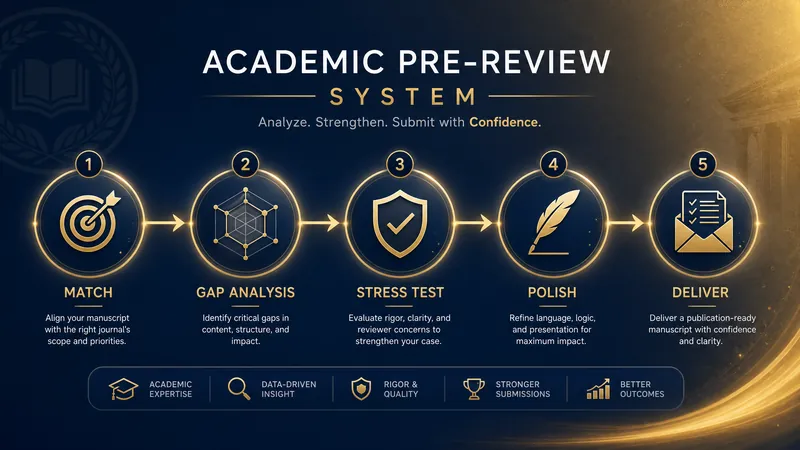
Top Journal Submission Pre-review Expert V7.0 is a full-process pre-review Skill for social sciences and humanities scholars. It simulates the perspective of senior reviewers at Nature/Science/ASR/AJS-level journals, driven by a dual-core engine (Reviewer Butcher + Polishing Craftsman) across six phases. V7.0 core upgrades: · Governance layer: unified dashboard + step mode (default/fast-forward/slow-motion) + ratchet version management + mid-join logic · All 15 quick commands implemented (/express /jump /benchmark /ethics-scan /cover-letter /polish /abstract /checklist /audit /resume /skip /rerun /export /persona /lang) · Cross-phase vulnerability tracking table: tracks from Phase 2 to Phase 5 with status closure · 6 virtual reviewer personas (methodology hawk, theoretical purist, contextualist, ethics reviewer, etc.), each with 4-5 typical criticisms, automatically activating 3-4 based on research type · Full language pair support: Chinese→English, English→English, Chinese→Chinese, with Chinglish terminator engine covering 7 categories of high-frequency errors · Benchmark paper five-dimensional comparison + no-benchmark degradation path · New AI usage transparency check and citation quality deep audit Applicable scenarios: PhD students/early-career faculty pre-submission self-check, advisors guiding students to revise manuscripts, research group submission strategy discussions. Supports full-process guidance for Chinese native speakers submitting in English.
Information
- Version
- v1
- Last updated
- Runtime credits
- Usage-based
- Models
- Auto