
Pre-Submission QC · 交稿前质检
双语交稿前质检 · AFP 五层 / Bilingual pre-delivery QC
Pre-Submission QC · 交稿前质检
双语交稿前质检 · AFP 五层 / Bilingual pre-delivery QC
Showcase
Description
在正式文档交付、提交或发布之前做质量把关,中英双语通用。技能按 Auto-Flow Prompt(AFP)五层工作流组织:触发层识别任务并建档;规划层按路由表生成检查项与执行计划;执行层自适应逐项复核(事实断言、确定性分级、任务漏项、数字口径、逻辑结构、合规隐私、可落地性、受众错位、专有名词、时效性、排版格式、图表链接附件、协作痕迹等);监督层以「检查→挑战→验证→修正→重测」回路自检并标注需人工干预项;集成层去重分级、解决跨项冲突并整合成报告。最终输出按 P0/P1/P2 分级的问题清单(含位置、依据、建议动作)和「可放行 / 修改后放行 / 不可放行」的总体结论。技能自动识别待查文档语言并用同一种语言产出报告,只报告、不修改文件、不自动发送或发布;最终放行权与责任在人。 Gate-keep quality before a formal document is delivered, submitted, or published, in Chinese or English. Organised as an Auto-Flow Prompt (AFP) five-layer workflow: the Trigger Layer recognises the task and sets up the file; the Planning Layer generates check items and an execution plan from the routing table; the Execution Layer adaptively reviews each item (factual claims, certainty levels, task omissions, numbers and bases, logic and structure, compliance and privacy, executability, recipient mismatch, proper nouns, timeliness, layout and formatting, figures/links/attachments, collaboration traces, and more); the Supervision Layer self-checks with a “check → challenge → verify → correct → retest” loop and flags items needing human intervention; the Integration Layer deduplicates and grades, resolves cross-item conflicts, and consolidates everything into a report. The final output is a P0/P1/P2 graded issue list (each with location, basis, and suggested action) plus an overall verdict of “Releasable / Releasable after revision / Not releasable”. The skill detects the target document’s language and produces the report in that language; it reports only — it does not modify files and does not auto-send or publish; the final release decision and responsibility rest with a human.
Related Skills
View all
Chinese Jargon & SVO Review
Rewrites Chinese materials that “sound professional but leave readers unsure who needs to do what” into language readers can understand, act on, and verify directly. It applies to reports, proposals, notices, articles, product documentation, project updates, policy training, customer service content, official WeChat articles, and AI-generated text, with a focus on Chinese jargon, vague slogans, abstract nouns, and writer-centered framing. Without changing facts, quantities, dates, names, scope, the strength of conclusions, or the boundaries of the evidence, this Skill turns difficult-to-act-on phrases such as “empower,” “strengthen management,” “drive implementation,” “close the loop,” and “align through collaboration” into more specific people, actions, objects, conditions, and outcomes. It also checks whether key sentences clearly state the subject, action, and object, so readers know who is responsible for what, what is affected, and how to determine whether the work is complete. When necessary, it retains specialized terms from regulations, standards, and products while adding explanations in plain language. The output typically includes a ready-to-use rewrite, the key changes that affect understanding, and any people responsible, timelines, data, evidence, or specialized definitions that cannot be confirmed from the original. It does not invent information or rewrite suggestions, records, or system statuses as facts that are completed, resolved, or verified. It is suited to writers, editors, and business teams who want to improve the readability, accuracy, and actionability of Chinese materials.
Proposal Readiness Checker
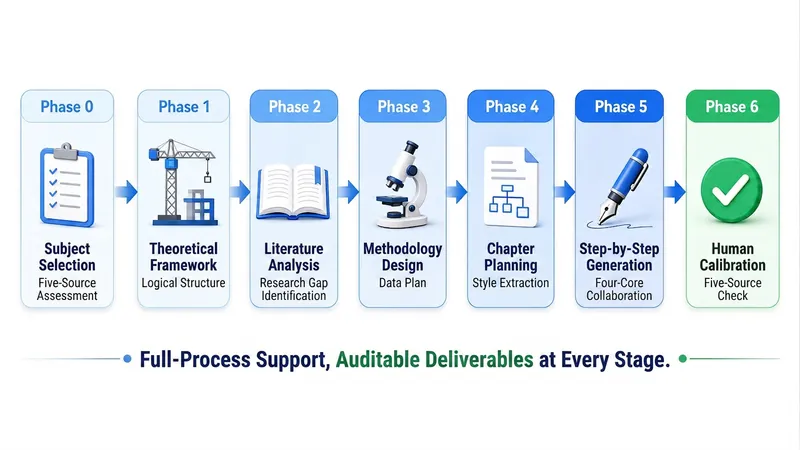
Before you spend dozens of hours writing your thesis, take ten minutes to run a structured checkup. This skill does only one thing: It diagnoses, not writes. It tells you whether your topic can hold up, whether your materials are sufficient, what's missing, where to fill the gaps, and in what order. Then it gives you an actionable missing-material checklist and search queries. It will not write your introduction, literature review, methods, or discussion. Four steps: 1. Discipline diagnosis: Classify your work into 1A Humanities/Arts, 1B Social Sciences, 2A Science/Engineering, or 2B Agriculture/Medicine/Life Sciences, and load the corresponding regulatory red lines; 2B triggers a mandatory ethics review block. 2. Topic checkup: Examine the topic from three dimensions—momentum, shape, and wording—to judge whether the research unit can be operationalized, whether the research question can be answered, and whether the topic has been done to death. 3. Material checkup: Register your existing literature into an M1/M2… material library, verify each entry against the four elements (author/year/title/verifiable locator), and compute the true coverage rate. 4. Gap list and search queries: Specify how many papers of what type are missing and which piece of evidence is lacking, and provide search queries ready to paste into databases (including Boolean keyword combinations, time ranges, and screening criteria). When to use it (trigger phrases): "Help me check my proposal" "Can this topic work?" "Do I have enough literature?" "My proposal was sent back" "I want to confirm before starting to write" — for graduate students who have just set a direction but haven't started writing; for those whose proposal was rejected but don't know why; for those with a pile of literature but unsure if it's enough to begin; for those wanting to confirm whether the topic is worth the investment before committing fully. Deliverables: A Proposal Checkup Report document + a Five-Source Readiness Scorecard (each level has behavioral criteria, not vague scoring) + a prioritized list of missing materials + search queries + an archive code. The archive code is compatible with the Academic Paper Full-Process Writing System v4.0; after the checkup, paste it there to continue writing without re-stating your discipline, topic, or journal. What this skill explicitly does not do: It does not write the main text, generate reference lists, or fabricate authors, years, volumes, issues, pages, or DOIs. Any literature found via online search is flagged with ⚠️ "needs verification" and must be verified by you before use. This skill does not promise any acceptance or passing outcome.
SCI Desk Reject Pre-check
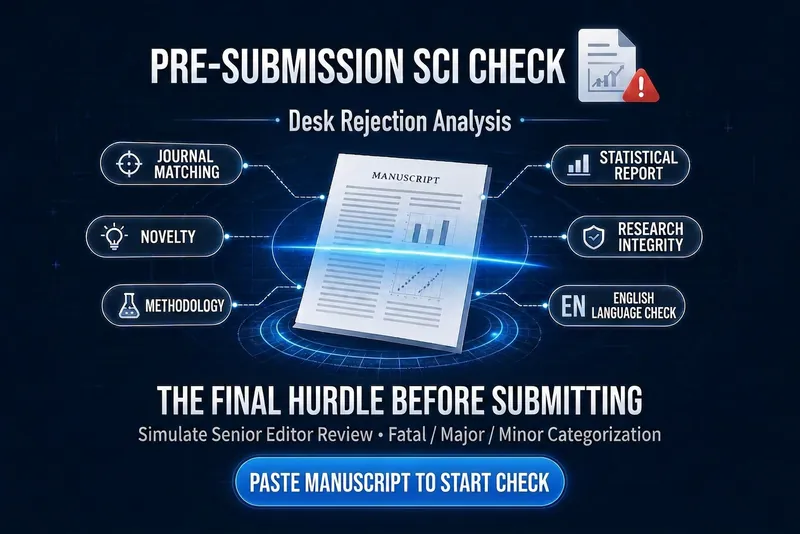
You spend months writing a manuscript, submit it—and three days later receive a rejection letter with no review comments. The editor-in-chief didn't even send it out for peer review; it was a desk rejection. 「SCI Desk Reject Pre-check」offers the initial screening perspective of a seasoned handling editor, helping you ensure quality before submission. What does it check? 📌 Journal Fit — Whether the topic aligns with the target journal's scope 🔍 Novelty and Contribution — Can the editor-in-chief identify your core contribution in 30 seconds? ⚗️ Methodology and Reproducibility — Design flaws and description gaps that trigger red flags 📊 Statistics and Quantitative Reporting — Issues in data presentation, significance, sample size, etc. 🛡️ Research Integrity and Ethics — Ethics approval, conflicts of interest, plagiarism check, AI disclosure, data availability 📝 Structure and Readability — Broken logic chains, weak abstracts, buried key information 🌐 English Language Risk — Whether language quality might trigger a language-based desk rejection All issues are categorized as 'Fatal / Major / Minor', each with actionable revision suggestions. Suitable for any SCI discipline: physics, chemistry, materials, engineering, life sciences, computer science, environment, geosciences, and more. Send your manuscript (or abstract + methods section) and start the check.
Information
- Version
- v5
- Last updated
- Runtime credits
- Usage-based
- Models
- Auto