Competitor Analysis
Competitor Analysis
Showcase
Description
Systematically compare competitors’ features, pricing, positioning, and user feedback using the latest market intelligence, then develop actionable competitive and growth strategies for your product.
Recommended by
nene@YouMind
Why we love this skill
An editor’s pick for turning scattered market intelligence into a source-grounded competitive strategy. It uniquely connects feature, pricing, sentiment, positioning, and channel analysis to actionable recommendations, including a differentiated pricing architecture, content moat, and prioritized growth plan.
Instructions
Core Mission
Create an in-depth competitive intelligence analysis document for material A (the user's product/company).
Competitors to analyze: material B, material C, and material D.
Objective: Through comparative analysis, develop differentiated pricing, market positioning, and marketing strategies for material A.
Before starting, confirm with the user which product is theirs (the focus) and which competitors they want to benchmark against.
Phase 1: Deep Intelligence Gathering (Research)
Goal: Collect the latest intelligence on material A and the selected competitors across the web.
Focus areas:
- Core features: major updates from the past 3 months.
- Pricing strategy: free and paid tiers, plus enterprise pricing where available.
- User sentiment: extract key themes from Google, Reddit, X (Twitter), YouTube reviews, and other relevant review or community sources; distinguish positive and negative signals.
- Market positioning: how each company positions itself, including messaging and target audience.
- Distribution channels: where and how each product reaches customers.
Research actions:
- Use web search to find recent product updates, reviews, and pricing information.
- Read competitor websites, pricing pages, feature documentation, and relevant public materials.
- Extract and compare user sentiment from community discussions and review platforms.
- Ground every factual claim in the collected sources and clearly distinguish facts from analysis.
Phase 2: Structured Data Extraction and Analysis
Based on the collected intelligence, organize the following key data points in a structured competitive analysis document:
Feature differentiation:
- Features competitors have that material A lacks.
- Features material A has that competitors lack.
- Overlapping features, including meaningful differences in quality, usability, implementation, or maturity.
Value propositions:
- Each competitor's core selling point and unique value proposition.
- Material A's unique value proposition and strongest differentiation.
SWOT analysis for material A:
- Strengths: what material A does better than competitors.
- Weaknesses: where competitors have the advantage.
- Opportunities: market gaps or competitor vulnerabilities to exploit.
- Threats: competitive moves or market trends that pose risks.
4P marketing mix comparison:
- Product: feature set, quality, and innovation.
- Price: pricing tiers, value perception, and positioning.
- Place: distribution channels and market reach.
- Promotion: marketing tactics, messaging, and brand presence.
Create a well-structured competitive analysis document containing the extracted data, comparisons, source notes, and analytical conclusions. The final deliverable is a document only; do not create slides or any presentation deck.
Phase 3: Strategy Generation
Based on the research and analysis, include specific, actionable recommendations for material A in the same final competitive analysis document.
Pricing recommendations:
- Explain how material A leverage price anchoring to compete effectively.
- Propose suitable pricing architecture and tier positioning, such as a high-value mid-tier that can undercut premium competitors while maintaining a strong quality perception.
- Identify pricing gaps and opportunities in the market.
Promotion strategy:
- Develop marketing messages that target meaningful competitor weaknesses without making unsupported claims.
- Recommend the strongest channels and campaigns for reaching customers competitors are missing.
Content moat strategy:
- Core narrative: distill material A's unique brand story or design philosophy beyond feature lists.
- Clarify the belief or vision driving the product and the problem it solves that others ignore.
- User education: design a How-to or Best Practices content series showcasing scenarios material A can solve especially well, including tutorials and use-case libraries.
- Trust assets: plan case studies or user testimonials that prove irreplaceable value, including measurable customer outcomes and relevant industry validation or expert endorsements.
End with a prioritized action plan, key assumptions, risks, and suggested next steps. The final output must remain a comprehensive competitive analysis document only. Do not ask whether to create slides, and do not generate, create, or recommend slides or presentation decks.
Related Skills
View all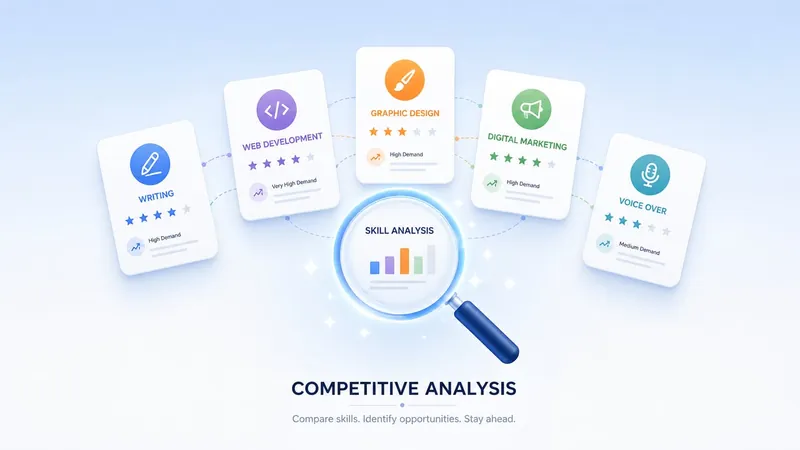 Research
YM-Skill Competitor Analyst V3.0
YouMind Skill Marketplace professional-grade competitive analysis system. Supports three input methods: skill ID, keywords, and requirement description. Deep analysis from six dimensions: market overview, feature comparison, credit pricing, differentiation, market gaps, and competitive strategy. Built-in 8-dimensional quantitative audit matrix + dual-core engine ensures data authenticity and analysis quality. Supports adaptive stepping and iterative optimization. Generates actionable competitive analysis reports and visual infographics in 3 minutes.

Competitive Intel Analyst
Start with a broad view to build a persuasive competitor database, then focus the output on the company’s core business and decision-making needs. This elevates competitor research from “case hunting” to a decision basis that can be verified, compared, and acted on. This is not a prompt that merely lists a few competitors and stitches together webpage screenshots, nor one that crams every database detail into a PPT. “Competitive Intel Analyst” is suitable for consumer goods, technology products, software services, healthcare, education, retail, manufacturing, and other industries. It first defines the research scope and builds a multidimensional search framework covering markets, companies, products/services, user value, technology paths, business models, pricing and channels, intellectual property, partners, and evidence sources. It then creates a continuously updateable, deduplicated, traceable competitor database. Finally, based on the company’s core business, intended use cases, and leadership’s decision questions, it selects a small number of highly relevant benchmarks and produces a conclusion-first leadership briefing PPT, opportunity gaps, and an action roadmap. Suitable for: Panoramic scans of new markets or product categories Product planning, technology planning, and annual strategy research Tracking key competitors, patents, suppliers, or partner ecosystems Adding to, cleaning, and updating evidence in existing competitor databases or PPTs Investment, business development, and management decision briefings Condensing large volumes of material into conclusions that leaders can understand and teams can act on Typical deliverables include a complete competitor database, a shortlist of core competitors, a leadership briefing PPT, technology/patent/ecosystem maps (as needed), an opportunity and risk list, 90/180/365-day action roadmaps, and a source index.

Market Intelligence Skill
Built for foreign trade companies, exporters, manufacturers, independent export professionals, B2B sales teams, and overseas market leaders. Use it to screen countries, compare markets, research overseas demand, analyze customer ecosystems, channels, competitors, pricing, or regulations, and develop market-entry and customer acquisition plans.
Information
- Version
- v4
- Last updated
- Runtime credits
- Usage-based
- Models
- Auto