
Chinese Punctuation Refresh
Correct Chinese punctuation in courses, articles, posts
Chinese Punctuation Refresh
Correct Chinese punctuation in courses, articles, posts
Showcase
Description
AI-generated articles often contain English punctuation, which is immediately recognizable in Chinese text. This skill fixes that by converting punctuation to Chinese standards in one go, making the text appear more authentic, standardized, and proper. It's especially useful for communities producing courses in bulk and editors fixing formatting issues in original manuscripts.
Instructions
Please standardize all punctuation marks in the following document to Chinese punctuation marks, according to the following rules:
【Core Rules】
1. Punctuation marks in Chinese contexts should uniformly use full-width Chinese punctuation marks:
- Change the English comma to a Chinese comma.
- Replace the English period with a Chinese period.
- Change the English colon to a Chinese colon:
- Change the English question mark "?" to the Chinese question mark "?"
- Change the English exclamation mark ! to a Chinese exclamation mark !
- Replace the English semicolon with a Chinese semicolon;
- Change English quotation marks "" to Chinese quotation marks "".
- Change English parentheses () to Chinese parentheses ().
- Change the English ellipsis... to a Chinese ellipsis...
2. Use a pause mark (、) instead of a comma (、) between parallel words.
[The situation remains unchanged]
1. All punctuation marks within a code block (enclosed in ```) must be modified if more than 80% of the content in a sentence is identified as Chinese. Otherwise, they remain unchanged.
2. Punctuation marks within inline code (content enclosed in backticks) remain unchanged.
3. Punctuation marks in formulas and functions should be in English.
4. Use English punctuation in URL links.
5. Punctuation marks in English sentences should maintain English style.
6. Punctuation marks in proper nouns and brand names should remain unchanged.
7. Use English punctuation for the decimal point and thousands place.
8. Markdown formatting tags (such as | and --- for tables) remain unchanged.
[Special Treatment]
1. Use Chinese colons after headings and subheadings:
2. Symbols following list item numbers:
- If the numbering is purely numerical (1. 2.), keep the period (full stop).
- If it is a Chinese serial number (e.g., first, second), it should be followed by a Chinese comma or colon.
3. Use Chinese punctuation marks for Chinese characters in image and screenshot placeholders.
[Key Inspection Points]
- Ensure that fixed formatting such as "Function Description:", "Syntax Format:", and "Parameter Explanation:" uses Chinese colons.
- Ensure that "Practical Case: xxx" uses a Chinese colon.
- Ensure that descriptive text outside the table uses Chinese punctuation.
- Comments and explanations outside the code examples use Chinese punctuation.
Please strictly follow the above rules when making modifications. Do not change the document's structure, format, or content; only adjust the punctuation.
Related Skills
View all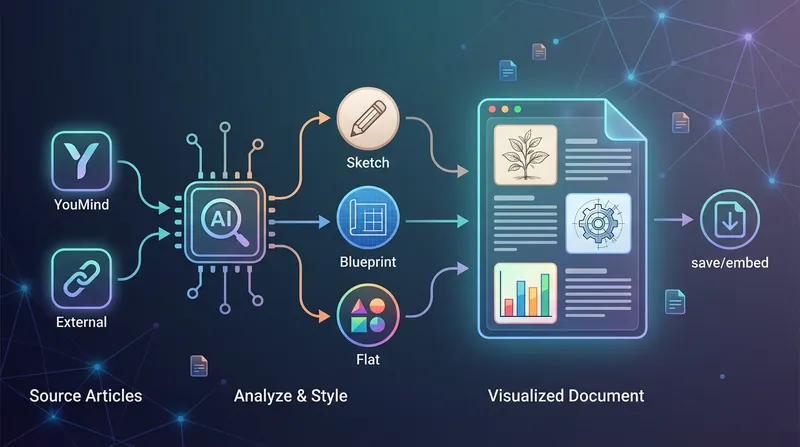 Image
ImageBatch Article Illustration 2.0
This is an intelligent visual enhancement tool designed for content creators. It deeply understands the flow of your text and automatically creates high-quality supporting illustrations for key paragraphs of your articles. Whether your content resides in a personal knowledge base or you need to process externally imported long-form articles, it accurately identifies core concepts, turning abstract text into concrete visual language and significantly improving the reading experience and shareability of your content. The tool offers three distinct visual styles to suit different creation scenarios: a fresh and lively minimalist hand-drawn style fits essays and popular science; a rigorous and professional architectural blueprint style is the ideal choice for technical documents and research reports; and a modern flat illustration style perfectly matches the aesthetic needs of social media accounts and knowledge notes. For long-form content, it also intelligently suggests illustration layouts to ensure a reasonable visual distribution with key points highlighted. During generation, you can flexibly choose how images are produced. You can have the generated illustrations seamlessly embedded directly into the original document paragraphs for automated layout, or you can opt to receive a standalone image resource package for manual distribution. This end-to-end collaboration, from content analysis to visual generation, makes your writing more impactful and complex ideas instantly clear.
 Write
WriteViral WeChat Post Writing 2.0
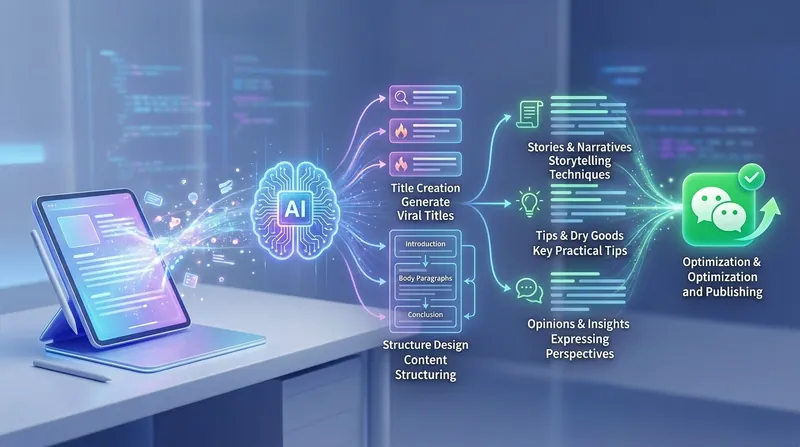
This skill helps creators efficiently produce WeChat articles. Whether you're sharing practical knowledge, expressing in-depth opinions, telling emotional stories, or promoting products, it offers end-to-end support from headline ideas to content writing, making your words more appealing in a mobile reading environment. During the writing process, it provides viral headline suggestions in various styles, including numeric, suspense, and contrast-based formats, and matches the most suitable structural framework to your article's topic. Whether you're crafting a logic-driven practical summary or an emotionally resonant narrative, it ensures clear structure and logical flow, precisely reaching your target audience. In addition, this skill includes professional layout optimization recommendations and quality checks. By controlling paragraph length, refining sentence rhythm, and enhancing the readability of key information, it elevates the overall quality of your content. It also assists with SEO keyword placement and conversion goal guidance, so every piece you write not only reads smoothly but also achieves the desired reach and conversion results.
 Write
WriteViral Article Engine Pro
Viral Article Engine Pro turns fragmented ideas, source material, or trending topics into in-depth WeChat Official Account articles with strong sharing potential. It is more than a text-generation tool: it is a content-planning expert that understands both algorithms and people. It precisely identifies readers’ emotional pain points and combines styles such as counterintuitive insights, advanced ideas made accessible, and articulating what readers are feeling, giving every article a distinct human touch and social-sharing value. This Skill features a newly upgraded “Obscure/Clear Dual-Track Headline System” and “Source-Driven Opening Decision System.” The headline system intelligently determines whether an article should follow the semantic-obscure or explicit-benefit track, supported by a 12-question self-checklist to eliminate formulaic patterns and overused hooks readers have learned to ignore. The opening decision system uses six types of source material (R1–R6) to precisely select from ten opening types (A–J), with uniqueness checks and an information-debt mechanism to ensure that every article begins in a distinctive way and connects tightly with the main body. To fully eliminate the “AI flavor,” the engine includes strict rules for removing machine-like writing and an immunity blacklist. It rejects hollow grand narratives, mechanical parallel structures, and headline formulas readers have already seen through. Instead, it favors specific scenes and an authentic tone, explaining experience to readers in a clear, conversational way—like a friend breaking it down piece by piece. In the end, you’ll receive a complete work that includes headline decisions, opening decisions, the main body, and an engagement strategy, helping your article stand out in the race for attention on the WeChat Official Account platform.
Information
- Version
- v2
- Last updated
- Runtime credits
- Usage-based
- Models
- Auto