
Emotion Engine: Child Meltdowns
Emotion Engine: Child Meltdowns
Showcase
Description
Child having a tantrum, talking back, crying, or easily triggered? The problem isn't that the child is difficult—it's that their emotional skills haven't caught up. Describe the situation in one sentence and get: ⚡ 30-Second Overview — emotion type + age group + one phrase to use today 📋 Complete Plan — not just soothing, but emotional containment + empathy scripts + environmental adjustments Includes: empathy formulas you can use today, how to change the physical environment, how to structure time with white space, a 7-day action checklist (printable for the fridge) 🔮 Learn for Next Time — if this is a tantrum, next time you'll know what to do for separation anxiety or social fear --- Applicable for ages 0-18, with strategies by age group | Not just for tantrums—works for anxiety, fear, withdrawal, and more 📚 Backed by classic psychological theory + brain science research + real-world cases 🙋 Refined over time from the triple perspective of mother, researcher, and teacher --- 💡 Suggested Companion Skills: - When your child is having emotional outbursts → Use this Skill - When your child is unmotivated and uninterested → Use "Motivation Engine: What to Do When Your Child Is Not Proactive" - When you know what to do but can't find the words → Use "One Strategy Per Situation: Custom Parenting Conversation"
Related Skills
View all
Tailored Parenting Dialogues
Waking up, sulking, seeing a news article... everyday little things are opportunities for seamless guidance. It helps you see the opportunity and know how to start a conversation. ⚡ Review Past Events 「My child came home today and said a classmate took his eraser and hasn't returned it. He's angry but afraid to tell the teacher.」 → We'll walk through: spot the opportunity, create the dialogue, listen attentively, respond effectively. A virtual practice so you'll feel confident next time in a similar situation; practice more and you'll be able to handle new scenarios on your own. 🔮 Anticipate What Hasn't Happened Yet 「Next week is parent-teacher conference; your child's grades have dropped — that conversation on the way home is a perfect opportunity for seamless guidance.」 → Prepare in advance how to say it, turning everyday moments (including possibly negative situations) into conversations your child can actually hear. Each Output ⚡ 30-Second Overview — A quick glance when you're busy shows you how to start. 📋 Complete Dialogue Plan — Spot, Create, Listen, Respond: four steps. Includes: three opening phrases (each with the exact words and rationale), branched contingency plans for listening and responding (possible child reactions + how you respond), and extrapolation. About the Author She has a natural sensitivity to the countless parenting situations in daily life. Where others see a child sulking, she sees a complete path: spot the opportunity, create the dialogue, listen attentively, respond effectively. For over two decades, this path has been refined through three identities: a mother's dedicated practice, a researcher's continuous observation, and a family education teacher's repeated reflection. The fusion of these three has given her mature and practical judgment on 'when and how to talk.' The logic behind this Skill comes from her over 20 years of dedicated observation and personal validation. Her own child left home early for studies, with little togetherness over the past decade, yet they have an excellent parent-child relationship that friends envy. It turns out that conversations nurtured with heart, emotion, and love withstand any separation. A good parent-child relationship doesn't rely on being together every day, but on speaking and listening the right way at the right moment. We're glad you've opened this Skill. Let's practice together step by step. :) 💡 Complementary Usage Suggestions: - Want to know how to say it? → Use this Skill. - Child doesn't want to do anything, no interest? → Use with 'Motivation Engine: What to do when your child is not proactive'. - Child's emotions out of control, explosive? → Use with 'Emotion Engine: What to do when your child is emotionally out of control'.
 Research
Coaching Parenting Assistant
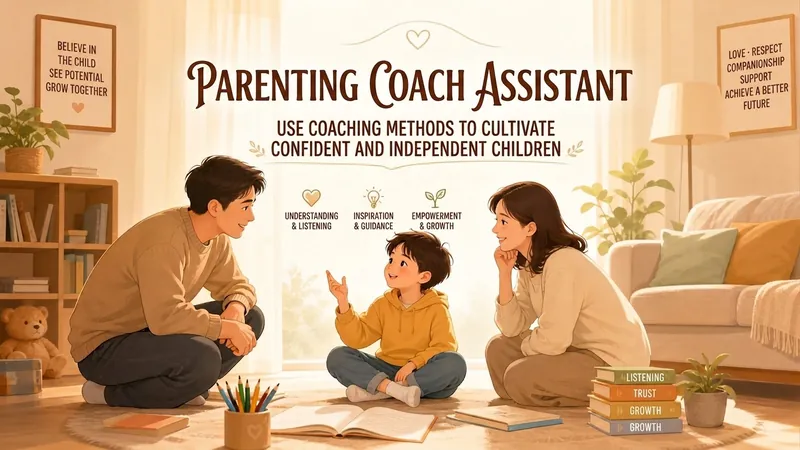
[闭嘴] Between you and your child, all it takes is the right way to speak. [汗] You've tried: Reasoning with him — he shuts the door. Losing your temper — you feel guiltier. Biting your tongue — nothing changes. Your family doesn't lack love, it lacks a set of coaching communication methods. Not coaxing, not preaching, not 'I'm doing this for your own good.' It's about letting the child say 'I want to do it,' not 'You want me to do it.' [玫瑰] This isn't empty inspiration. It's the core methodology of a 3980-yuan coaching parenting course — the **See → Be Curious → Inspire → Co-create** four-step dialogue framework. - Kid addicted to phone? Not confiscation, it's setting boundaries together. - Anxious and slacking off before exams? Not saying 'You can do it,' but asking 'What do you need?' - You say ten words and he talks back? Change how you ask so he speaks up himself. [咖啡] This skill solves the everyday communication chaos in your home. And along the way, it lights up your child's inner drive.

Parent-Child Communication Coach
Helps parents of children aged 6–18 improve parent-child communication, understand the possible reasons behind behaviors like procrastination, refusal, emotional outbursts, and task initiation difficulties, and find more appropriate responses in real family scenarios. Whether dealing with a learning conflict, parental anxiety and helplessness, or a child's long-term lack of self-management, you can receive gentle, professional, and concrete support. You will get ready-to-use communication scripts, scenario-based response advice, and clear next steps, such as how to help a child take the first step, how to preserve choices while upholding rules, how to reduce repeated urging and confrontation, and how to adjust methods based on the child's age, abilities, emotional state, and task difficulty. Recommendations focus on the development of environment, behavior, executive functions, beliefs, and autonomy, rather than simply labeling a child as 'lazy' or 'undisciplined'. When you need long-term improvement, it can also assist in formulating phased execution development plans, observing changes in task initiation, completion rates, reminder frequencies, independent completion ratios, and parent-child conflicts, and continuously reviewing and adjusting based on practical feedback. The goal is not to pursue short-term obedience or guaranteed grade increases, but to help parents gradually reduce ineffective control, allowing children to develop self-planning, self-monitoring, and problem-solving skills through manageable, small steps. For situations that continuously impact learning, sleep, or daily functioning, it will also remind you to seek appropriate professional evaluation.
Information
- Version
- v4
- Last updated
- Runtime credits
- Usage-based
- Models
- Auto
