Business Archaeologist
Business Archaeologist
Showcase
Description
From an investor's perspective, deeply analyze a company's success logic, providing multi-source verified research support for journalists writing Acquired-style business histories. Adapts to the company's age, balancing information density across periods.
Related Skills
View all
Business Logic Analyst
An analytical tool that deeply deconstructs corporate business logic. Through intelligent matching of mental models (7 Powers, flywheel, marginal cost, etc.), identifying logic gaps, and extracting transferable methodologies, it transforms complex business narratives into structured strategic insights. Suitable for secondary in-depth analysis based on the research reports of the "Business Archaeologist".

Competitive Intel Analyst
Start with a broad view to build a persuasive competitor database, then focus the output on the company’s core business and decision-making needs. This elevates competitor research from “case hunting” to a decision basis that can be verified, compared, and acted on. This is not a prompt that merely lists a few competitors and stitches together webpage screenshots, nor one that crams every database detail into a PPT. “Competitive Intel Analyst” is suitable for consumer goods, technology products, software services, healthcare, education, retail, manufacturing, and other industries. It first defines the research scope and builds a multidimensional search framework covering markets, companies, products/services, user value, technology paths, business models, pricing and channels, intellectual property, partners, and evidence sources. It then creates a continuously updateable, deduplicated, traceable competitor database. Finally, based on the company’s core business, intended use cases, and leadership’s decision questions, it selects a small number of highly relevant benchmarks and produces a conclusion-first leadership briefing PPT, opportunity gaps, and an action roadmap. Suitable for: Panoramic scans of new markets or product categories Product planning, technology planning, and annual strategy research Tracking key competitors, patents, suppliers, or partner ecosystems Adding to, cleaning, and updating evidence in existing competitor databases or PPTs Investment, business development, and management decision briefings Condensing large volumes of material into conclusions that leaders can understand and teams can act on Typical deliverables include a complete competitor database, a shortlist of core competitors, a leadership briefing PPT, technology/patent/ecosystem maps (as needed), an opportunity and risk list, 90/180/365-day action roadmaps, and a source index.
 Research
Consumer Brand Lab
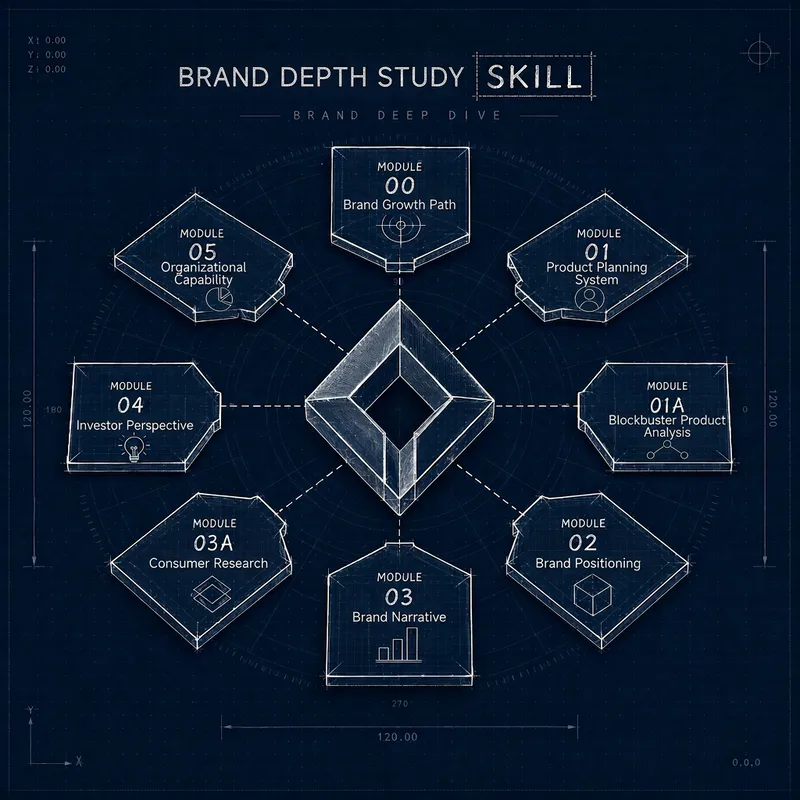
Most people assess brands through their websites, ads, and trending topics—that’s what brands want you to see. The true logic of a brand is hidden in its product structure, pricing, channels, breakout products, user discussions, and financial statements. This Skill takes any brand and, through 2–4 rounds of in-depth web research, reconstructs a complete Operating System spanning “Founder Origin → Brand Formation → Style Evolution → Product Assets → Hero Product Formation → Organizational Capabilities → Brand Growth → Current State”: covering the Founder → Brand Causality Map, brand history and turning points, style evolution and Brand Code, product architecture and Hero Product Portfolio, growth path and evolution of brand assets, then consolidating the findings into a Brand Operating System document series (positioning reverse-engineering, narrative system, investor perspective, organizational capabilities, growth path, product planning + Hero Product lifecycle and breakout path research). It strictly distinguishes evidence-backed facts from reasonable inferences, preserves source citations item by item, and does not fabricate data, sales, rankings, repurchase rates, causality, or quotations. The output is not a brand story, but a reusable brand operating system for brand strategy reference and competitive analysis.
Information
- Version
- v1
- Last updated
- Runtime credits
- Usage-based
- Models
- Auto
