AFP Image Prompt Architect
AFP Image Prompt Architect
Showcase
Description
A universal AI image prompt system based on the AFP (Auto-Flow Prompt) architecture. It is adapted for brand posters, social covers, knowledge cards, product images, IP characters, infographics, and more, optimized for GPT-image-2. The system actively collects requirements through a pull interaction mode and features built-in type routing, visual metaphor mapping, multi-core quality checks, Chinese language protection, and anti-jailbreak mechanisms to ensure structured, high-quality, ready-to-use image prompts.
Related Skills
View all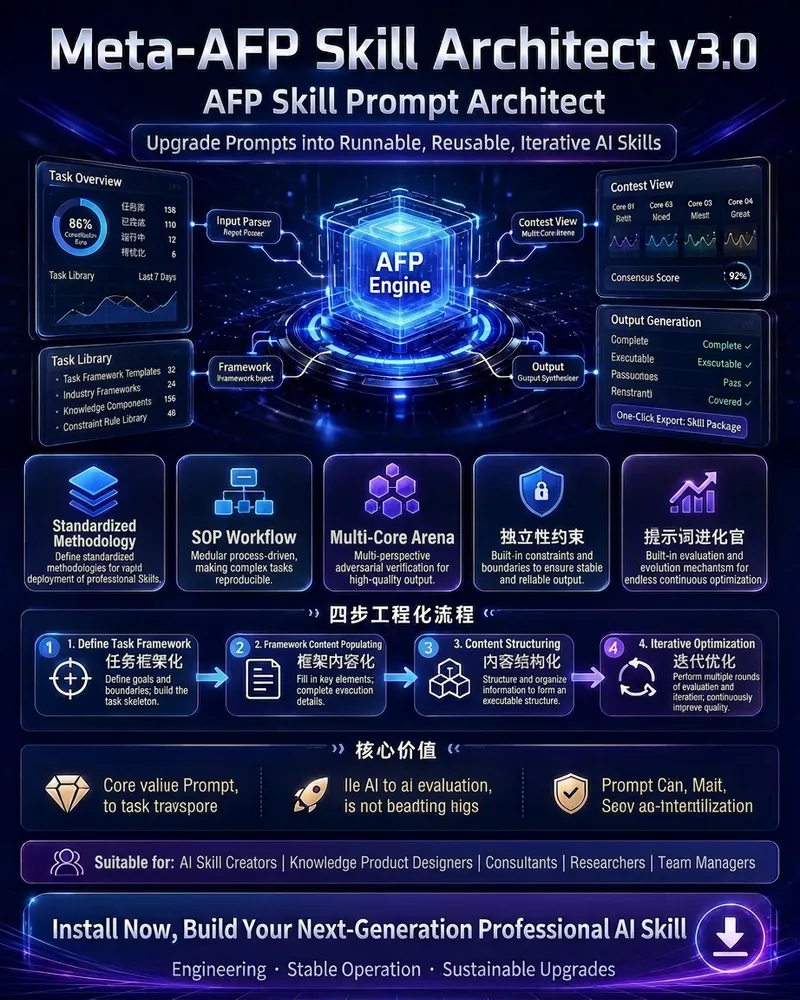
Meta-AFP Prompt Architect
An engineered meta-prompt generation system v3.0 based on the AFP (Auto-Flow Prompt) methodology. Transforms vague needs into runnable, reusable, iterative, and assetable system-level prompts—running like an operating system, thinking like an expert team, and as stable as military-grade products. Integrates a complete methodology including five generations of prompt evolution, three dimensions of content alchemy, six orchestration algorithms, dual-core/multi-core confrontation, hard rules for independence constraints, five audit principles, regression/stress testing, a security moat (separator isolation, sandwich defense, meta-instruction declaration, black-box encapsulation), a prompt evolution officer self-evolution mechanism, and the AFP asset valuation model (Expertise × Structure × Frequency). Suitable for creating high-value Skills in fields such as academic writing, legal audit, business analysis, content production, sales copywriting, knowledge management, and intelligent agents.
 Research
AFP Super Prompt Architect
Based on the Auto-Flow Prompt methodology, this Skill transforms vague requirements into super prompts with programmatic execution, SOP workflows, multi-core adversarial checks, and panoramic dashboards. It automatically assesses task complexity and outputs a lightweight or full-scale AFP architecture as needed.

AFP Engineered Prompt Generator
AFP Engineered Prompt Generator · Master-Level System Architecture 🎯 Core Positioning: A meta-level prompt engineering system — used to generate foundational architecture for other AFP domain skills. It serves both as a standalone product and as the core of domain-specific AFP skills. 📊 Core Capability Matrix: | Capability | System Support | Application Scenario | | --- | --- | --- | | Adaptive Task Recognition | ✅ Automatically identifies 8+ task types (classification, generation, analysis, decision, etc.) | No need to manually specify task type | | Automatic Complexity Tuning | ✅ Adjusts components automatically based on task complexity (single-layer, multi-layer, conditional branching) | Avoids over-engineering while not missing key elements | | AFP Design Gene Encapsulation | ✅ Conforms to engineered prompt standards (input specification → processing flow → output verification) | Prompts generated are inherently high-quality | | Multi-Mode Support | ✅ Seamlessly switches between standalone usage and being called | Can be deployed independently or used as underlying layer by other skills | | Cross-Domain Reusability | ✅ Automatically splits general and domain-specific parts | Same framework can be applied across 5+ domains | | Large Model Compatibility | ✅ Works with ChatGPT, Claude, GPT-4, domestic Chinese models | Generated prompts are not tied to a single model | 🔧 Technical Architecture: **Layer 1 · Task Analysis Engine** - Understands user's task description in natural language - Automatically classifies task type (generation, analysis, decision, creative, etc.) - Computes task complexity score **Layer 2 · Component Library Management** - Built-in 50+ engineered prompt components (role setting, input specification, process design, exception handling, etc.) - Tagged by complexity level (L0 simple / L1 medium / L2 advanced / L3 expert) - Supports selective assembly and custom expansion of components **Layer 3 · AFP Framework Generation** - Organizes prompt structure following AFP design gene (function layering → process orchestration → output formatting) - Automatically generates complete instruction chain - Built-in quality inspection (coverage, redundancy, consistency checks) **Layer 4 · Output and Integration** - Generates plain text prompts (ready to use) - Generates structured configuration files (callable by programs) - Supports version management and iterative optimization 📈 Expected Effect Metrics: | Metric | Improvement | Description | | --- | --- | --- | | Prompt design cycle | From 1-2 weeks → 10-30 minutes | From manual design to automatic generation | | Output quality stability | From 70-80% → 85-92% | Engineered design is inherently more stable | | Cross-domain reuse rate | From 30% → 80%+ | General and special parts are automatically separated | | Team learning cost | From 3-6 months mastery → 1-2 weeks onboarding | New members can quickly reuse quality frameworks | | Large model migration cost | From full rewrite → partial fine-tuning | Framework is stable, model upgrades don't require major changes |
Information
- Version
- v2
- Last updated
- Runtime credits
- Usage-based
- Models
- Auto