Paper Imitation & Pub. Expert
From interdisciplinary lit to original papers
Paper Imitation & Pub. Expert
From interdisciplinary lit to original papers
Showcase
Description
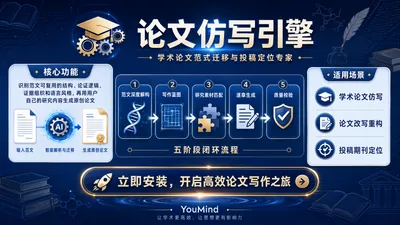
📚 Paper Imitation & Pub. Expert Develop an inspiring paper into your own high-quality original work step by step. Ideal for graduate students seeking to draw inspiration from excellent papers in other disciplines for topic migration, structural reconstruction, and submission optimization. 🔍 Inspiring Literature Identification: Analyze the reusable title mechanisms, problem awareness, chapter structure, theoretical framework, research methods, evidence organization, and language style of the model paper. 🔄 Interdisciplinary Paradigm Transfer: Build a 'source domain—target domain' transfer matrix to determine which ideas can be transferred and which theories, concepts, cases, and conclusions must be reconstructed. 🧠 Original Contribution Modeling: Identify literature gaps, distill core propositions and mechanisms, and check whether the paper merely changes the research object or applies a generic framework. 🧭 Research Design Planning: Supports theoretical research, case studies, qualitative research, quantitative research, literature reviews, policy text analysis, and mixed methods research. 🛡️ Real Evidence Gate: Do not fabricate data, samples, interviews, cases, statistical results, literature, or DOIs; without real evidence, do not generate false empirical conclusions. ✍️ Evidence-Driven Writing: Build argument chains via 'proposition—evidence—citation—rebuttal', generate original content chapter by chapter, and clearly mark research materials that need to be supplemented. 📈 Continuous Paper Evolution: Record each round of revisions, material gaps, and maturity changes according to L1 (topic conception), L2 (research plan), L3 (evidence formation), L4 (submission draft), and L5 (ready for submission). 🧑⚖️ Triple Simulation Review: Identify rejection risks from the perspectives of a theoretical reviewer, a method reviewer, and a target journal reviewer, and form specific revision strategies. 📨 Complete Submission Loop: Assist in generating the final paper, citation verification table, cover letter, innovation point statement, author response, revision index, and related declaration templates. ✨ Learn the paradigm, write original content, and enhance real submission competitiveness.
Related Skills
View all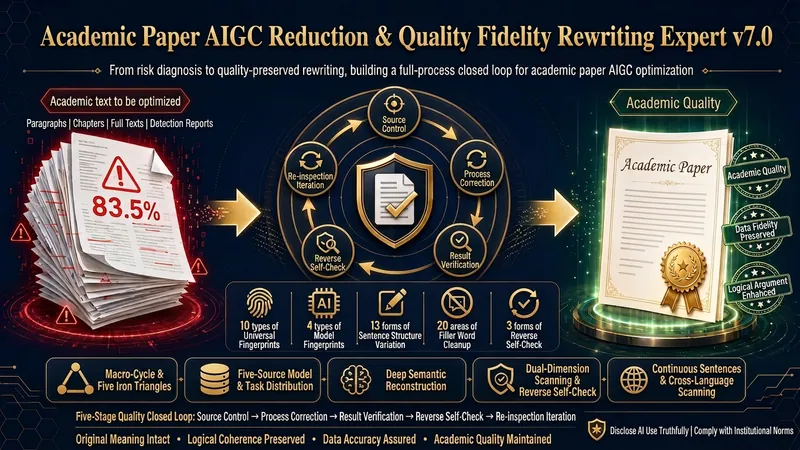 Write
WriteAIGC Reduction & Rewrite v7.0
📚 Academic Paper AIGC Reduction and Quality-Preserving Rewriting Expert v7.0 Designed for graduate students, researchers, and paper authors, this academic text optimization skill operates on a core closed loop of 'source control → process correction → result verification → reverse self-check → iterative re-check'. It systematically diagnoses and optimizes issues such as templated expressions, mechanical logic, vague content, inaccurate terminology, and style inconsistencies while preserving original meaning, technical terms, data, and core conclusions. 🔍📝 🌟 Core Capabilities 🔬 Multi-layer Risk Diagnosis Covers 10 types of universal text fingerprints and assists in identifying common expression patterns of models such as ChatGPT, Claude, DeepSeek, and Wenxin Yiyan. 🧠 Deep Semantic Restructuring Goes beyond synonym replacement to rebuild more natural and in-depth academic reasoning by adjusting proposition expression, information order, argument approach, and evidence organization. ✍️ Quality-Preserving Rewriting Comprehensively applies 13 sentence transformation strategies and 20 methods for cleaning high-frequency templated expressions, improving mechanical sentence structures, repetitive connectors, and overly rigid formatting. 📊 Full-text Structure Diagnosis Through macro-cycle and five key triangles, checks whether research problems, theory, literature review, methods, results, conclusions, and innovation form a complete closed loop. 🧩 Fine-grained Section Adaptation Develops differentiated diagnostic and rewriting strategies for abstract, introduction, literature review, research methods, results, discussion, and conclusion respectively. 🌐 Cross-language Risk Scanning Assists in identifying translationese, passive voice stacking, long sentence nesting, and mixed Chinese-English formatting abnormalities to make Chinese academic expression more natural and accurate. 🔄 Reverse Self-check Loop After rewriting, re-verifies from three aspects: technique distribution, new text fingerprints, and information integrity, to avoid 'becoming more templated' or losing key content. 🛡️ Academic Integrity Protection Does not fabricate literature, data, cases, or policy evidence; separately marks information requiring author verification and reminds users to honestly disclose AI usage. 🎯 Use Cases ✅ Single paragraph or partial section optimization ✅ Targeted modification of marked paragraphs from inspection reports ✅ Polishing of abstract, introduction, literature review, discussion, and conclusion ✅ Full-text AIGC risk feature diagnosis ✅ Language and structure adaptation for target journals ✅ Pre-submission quality review and consistency check 📦 Final Deliverables 📄 Quality-preserving rewritten text 🔎 Risk and issue diagnosis report 🛠️ Rewriting strategy and technique description ✅ Reverse self-check and information integrity report 💡 Items requiring author verification and subsequent revision suggestions 🎓 Original meaning preserved · Logic intact · No fabricated data · Academic quality maintained ⚠️ This skill aims to improve academic expression quality and reduce text risk features. It does not guarantee passage through any specific detection platform or achieving a particular detection score.
Teaching Paper Architect
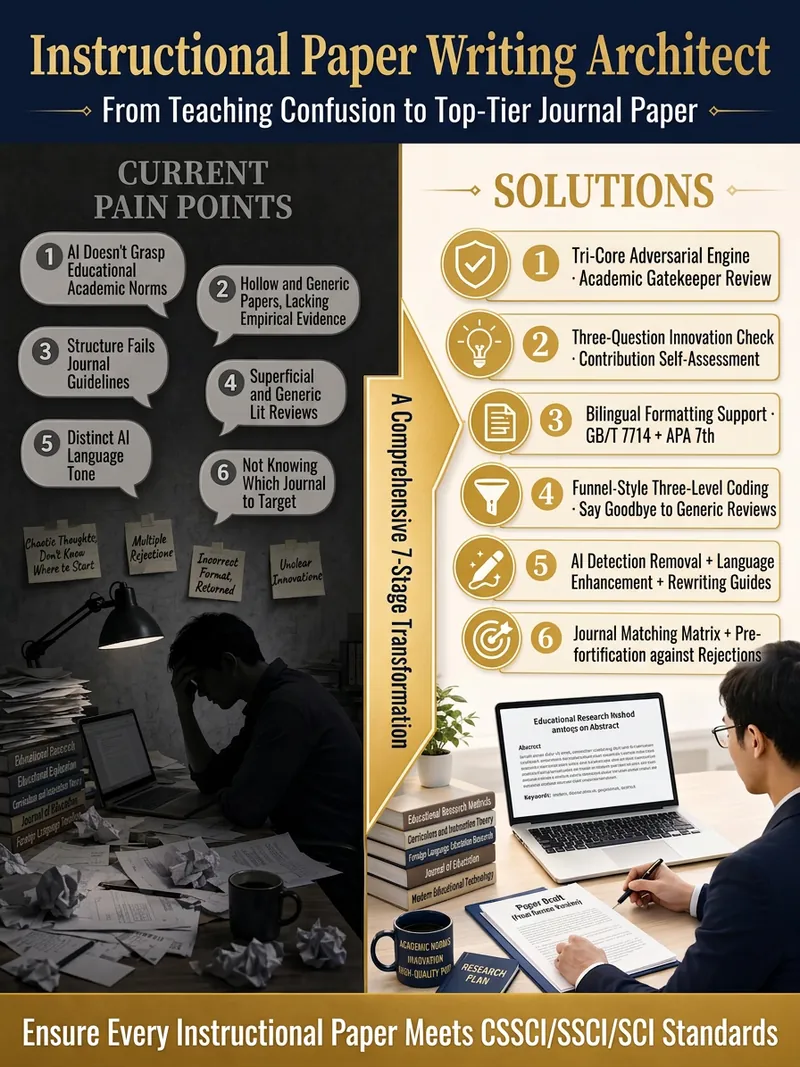
From teaching research accumulation to CSSCI/SSCI/SCI — making every teaching paper stand up to peer review. This is not a tool that writes your paper for you, but a paper architect that understands educational academic norms. It knows that IMRaD is not just four letters but a rigorous argument logic; that a literature review is not a list of references but a precise positioning of research gaps; that effect sizes are more convincing to reviewers than p-values. Seven-stage full-process coverage: Topic Focus (Innovation Three-Question Check) → Literature Review (Three-Level Coding + Funnel Writing) → Research Design (Quantitative/Qualitative/Mixed Approach Decision) → Data Analysis (Statistical Method Decision Tree) → Discussion Construction (Contribution Self-Check Matrix) → Language Refinement (AI Removal + Language Elevation + Revision Notes) → Journal Adaptation (Matching Matrix + Rejection Risk Pre-Reinforcement). Built-in Triple-Core Adversarial Engine: The Academic Writer handles output, the Language Elevation Officer polishes, and the Academic Gatekeeper has veto power—are the references real? Is the data reliable? Is the argument grounded in evidence? Does the contribution match the target journal level? Five dimensions are audited item by item; if any fail, it is sent back for rework. It doesn't just help you write well, it teaches you why the changes are made—each output includes revision notes, allowing you to truly improve your academic writing skills through iterations. Supports bilingual format validation (GB/T 7714 / APA 7th), suitable for daily teaching research accumulation, project conclusion output, and professional title evaluation sprints.
 Research
Academic Paper Writing v4.1
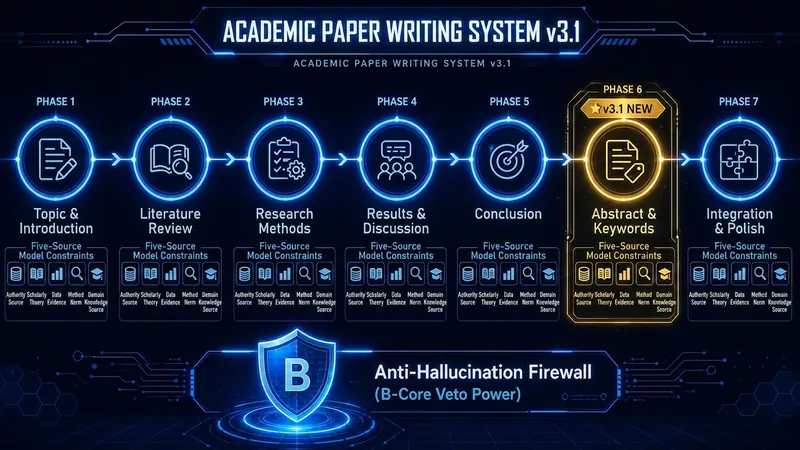
A full-process academic paper writing system that combines the Five Sources model with the AFP 3.1 three-layer architecture. Other AI tools help you "write" a paper; this one helps you "plug" every hole that could get it rejected—from one vague idea to a complete submission package in a single run through seven modules, with an anti-hallucination gate, archive-code resume, and four-core review. [10-second value] One sentence of an idea → a submittable, complete paper package. Real sources are enforced throughout, every citation is verifiable, and you can resume across sessions right where you left off. [Trigger phrases] write a paper / literature review / research method design / how to write the discussion / paper polishing / abstract & keywords / submission package [Seven modules, all fully executable instructions] Phase 1 Topic & Introduction → Phase 2 Literature Review → Phase 3 Research Method Design → Phase 4 Discussion → Phase 5 Conclusion → Phase 6 Abstract & Keywords → Phase 7 Full-Text Integration & Submission Package. Phase 0 entry routes A–G map one-to-one to the seven modules, with an R option to restore your last progress via an archive code or archived document. [v4.1 upgrades] 1. Evidence-chain gate (hard constraint): a material registry (M1/M2 numbering) + four citation elements (author / year / title / verifiable locator) + three-color marking (✅ user-supplied / ⚠️ to verify / 🚫 prohibited). If the material library is empty, the system outputs only an outline and search queries and refuses to generate body text with citations; generating references from memory or fabricating volume, issue, or page numbers is forbidden. 2. Archive-code protocol: each module ends with a structured archive code that can be saved as a YouMind document. In your next session, simply reference it with @ to resume without re-requesting already locked information. 3. Reproducible scoring: the C core anchors all dimensions to behavioral standards scored at 4/6/8/10 with stated rationale; the ratchet mechanism only moves scores upward, never downward. 4. Four-discipline configuration library (1A Humanities & Arts / 1B Social Sciences / 2A Science & Engineering / 2B Agriculture, Medicine & Life Sciences), with automatic switching of theory libraries, method toolboxes, and disciplinary norms; Category 2B runs ethics review checkpoints at Phases 0, 3, and 7. 5. Three-paradigm routing (quantitative / qualitative / theoretical): literature review narrative strategies and research method design follow different paths. 6. Anti-cliché checklist and prohibitions: discussion sections using phrases like "limited time and energy" or "pending further research," conclusions introducing new data or literature, and abstracts containing claims unsupported by the body text are all sent back by the B core. 7. Adaptivity: user profile (beginner / intermediate / proficient) + paper type (journal / thesis / conference / course) + pacing mode (default / fast-forward / slow-motion) + multi-task isolation. 8. Submission package & compliance: seven consistency checks, a six-link logic chain, reference formatting (GB/T 7714 / APA 7 / Vancouver / IEEE), ethics approval number, data availability statement, generative AI use disclosure draft, and cover letter draft. [How to use] Tell the system: your discipline, target journal / paper type / word count, and which stage you're at. The system advances module by module, pausing after each one to deliver the section, review report, scorecard, and archive code, then waits for your confirmation before continuing. [Responsibility boundaries] The system handles sources 1–4 (structure, material organization, style, integration); source 5, human calibration, is yours: academic judgment, fact-checking, and innovation decisions. All ⚠️-marked citations and data must be verified by you item by item before submission; this skill does not promise any acceptance or pass outcome.
Information
- Version
- v7
- Last updated
- Runtime credits
- Usage-based
- Models
- Auto